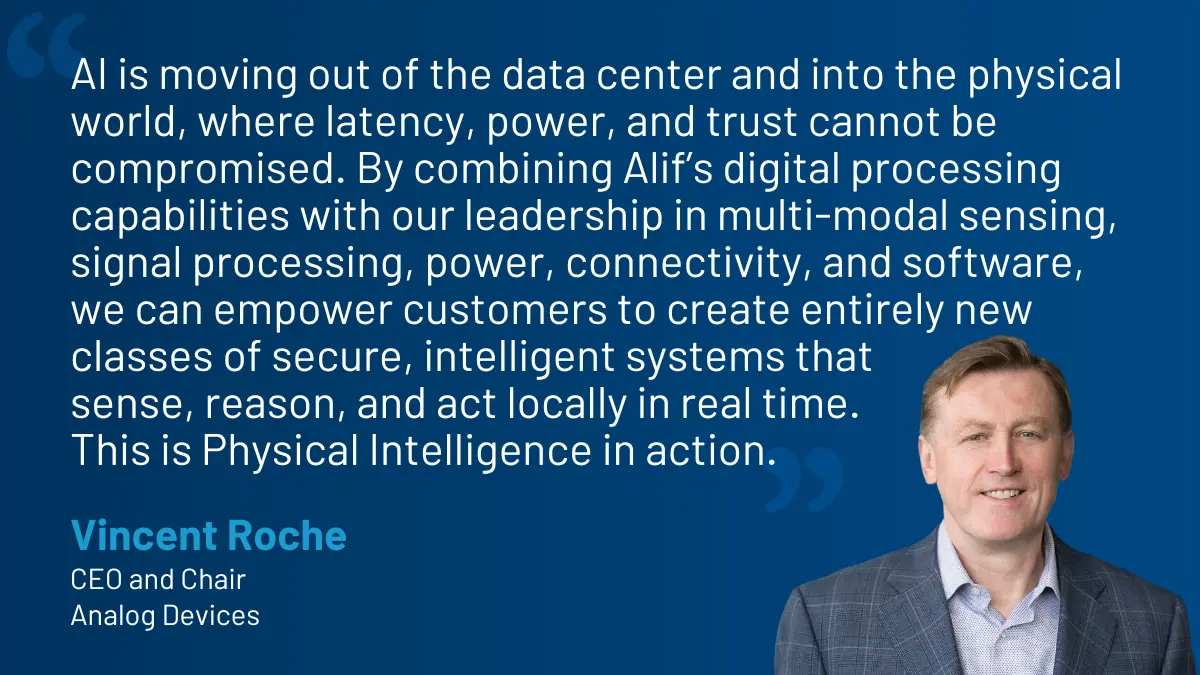
Analog Devices and Alif Semiconductor announced a definitive acquisition agreement on September 9. ADI will pay Alif's stockholders $1.35 billion in cash upfront and could pay up to another $200 million if contingent conditions are met.
Buying the digital layer for edge intelligence
Alif builds low-power microcontrollers and fusion processors designed to combine sensor inputs, connectivity, security, graphics, and neural processing on the device. Its architecture targets applications where latency, power use, privacy, or reliability make continuous cloud inference impractical.
ADI already supplies sensing, signal-processing, power-management, connectivity, and software components across industrial and embedded markets. The strategic case is to join those analog capabilities with Alif's digital and neural-processing platform, giving customers a more complete stack for systems that sense conditions and act locally.
Physical AI is broadening semiconductor dealmaking
The target markets named by ADI span industrial equipment, robotics, defense, energy, digital health, wearables, and data-center infrastructure. That breadth shows how AI semiconductor activity is moving beyond accelerators for training large models: inference is also being embedded in battery-constrained and real-time systems at the network edge.
ADI says Alif's silicon is already shipping in production and has design wins with consumer and industrial customers. Reuters independently confirmed the announced consideration and the companies' description of the proposed combination, but neither source discloses Alif's revenue, shipment volume, or the financial contribution ADI expects after integration.
An agreement, not a completed acquisition
Both boards have approved the agreement, and the companies expect completion before the end of calendar 2026. Closing still depends on customary conditions and the applicable U.S. antitrust waiting period. Until those steps are completed, Alif remains independent and the claimed product and market benefits remain management expectations rather than realized outcomes.