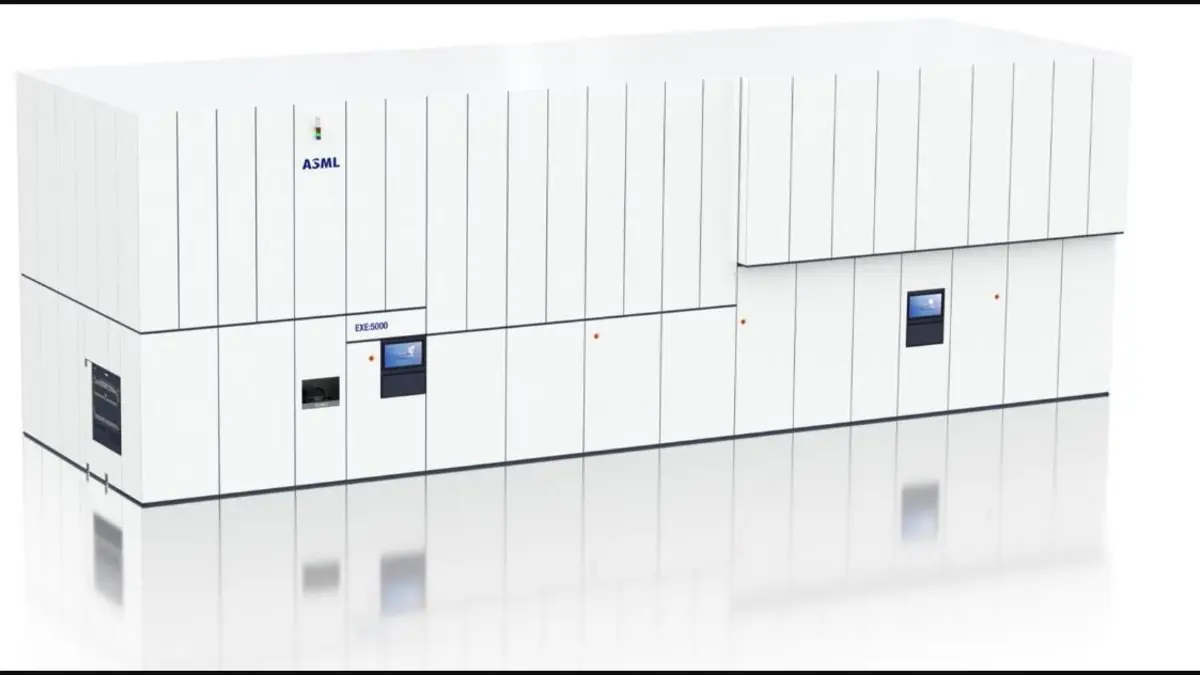
ASML’s High-NA extreme-ultraviolet lithography is moving from an equipment roadmap toward customer production plans. Reuters reported on September 14 that ASML’s current EUV tools are nearly sold out through 2027 and that customers have made commitments to the next generation of roughly $400 million High-NA systems. TSMC, Samsung, and SK Hynix have set production dates, while Intel says the tools meet its throughput and reliability needs.
A tighter patterning step for AI chips
ASML describes the TWINSCAN EXE:5000 as the first 0.55 numerical-aperture High-NA EUV system. Its product page says the system delivers 8 nm resolution, enables single-exposure features 1.7 times smaller than the preceding NXE platform, and can support 2.9 times higher transistor density. Those capabilities are relevant to the advanced logic and memory supply chain behind AI accelerators, although the product specifications do not establish customer yield or volume production.
Commitments are not yet deployed capacity
The next step is execution: installing tools, qualifying processes, and reaching repeatable production at each customer. Reuters says High-NA systems cost about twice as much as current EUV tools and that TSMC is targeting production use around 2030. Customer commitments and announced dates therefore signal a future manufacturing transition, not immediate additional AI-chip supply.
ASML’s position also makes the roadmap strategically important. Reuters reported that the company has no commercial EUV rival and held about 94% of the broader lithography market in 2025. The concentration gives ASML a critical role in the pace and economics of future accelerator nodes, while the public evidence still leaves actual High-NA ramp timing and customer output uncertain.