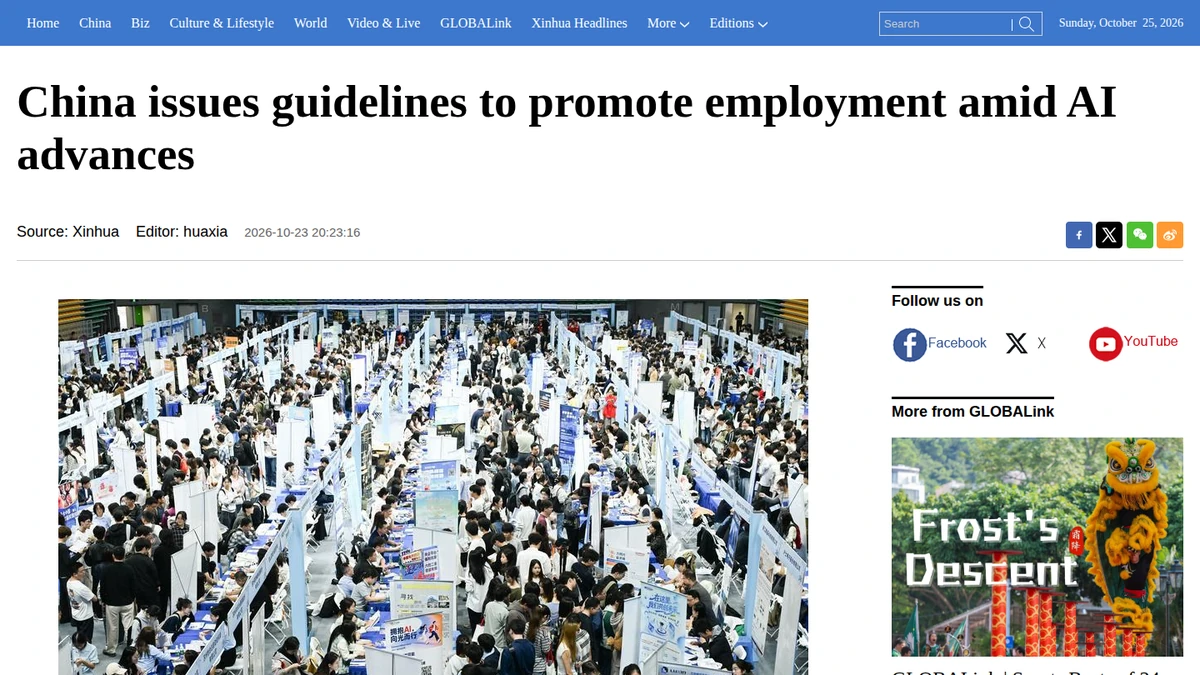
China’s State Council has issued a national framework for adapting labor policy to artificial intelligence. The guidelines set out 18 tasks in six areas: expanding AI-enabled job creation, making adoption more employment-friendly, improving digital skills, strengthening employment services, protecting workers and monitoring labor-market risks.
Adoption with explicit displacement controls
The plan asks authorities to develop new AI-related occupations and entrepreneurship while also helping small and medium-sized businesses stabilize employment. It calls for AI’s job-creation potential to be used in traditional sectors, but pairs that instruction with measures to mitigate displacement from AI applications.
Risk assessment is central to the framework. The government wants a mechanism for measuring employment effects, alongside stronger services for workers moving between roles. It also highlights rights in human-machine collaboration and social-security coverage for flexible and emerging forms of work.
A policy signal, with execution still ahead
The guidelines mark a shift from discussing AI chiefly as an industrial capability to treating its labor consequences as a national policy domain. They do not reject automation. Instead, they try to channel adoption toward applications that add jobs or improve work while creating monitoring and protection mechanisms for losses.
The document is a central-government directive rather than a completed implementation program. Its practical effect will depend on how ministries, provinces and employers define risk thresholds, finance training, enforce worker protections and report displacement.