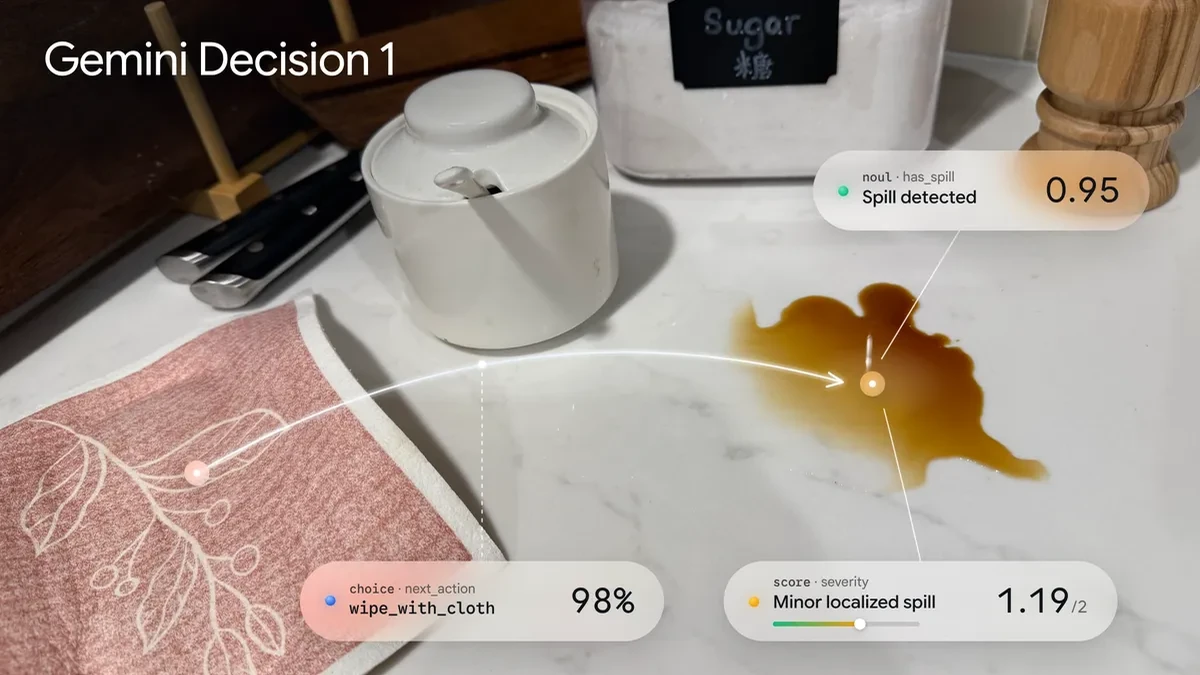
Google introduced the Gemini Decisions API on November 11, powered by a new model it calls Gemini Decision 1. The endpoint is designed for closed-set tasks such as choosing among options, routing requests, checking policy rules and grading content. Instead of generating a paragraph one token at a time, it scores candidate answers and returns probabilities and confidence scores.
A single request can contain up to 1,000 independent questions over text, images, audio, video and PDFs, with input contexts of up to 256,000 tokens. Google lists 150–250 milliseconds of end-to-end latency and a price of $0.10 per million input tokens, with no output tokens billed. These are the vendor's stated product limits and pricing at launch.
The API is available through Google's Gemini API and AI Studio. Its design targets cases where an application needs a bounded decision quickly, rather than a conversational explanation. For example, a developer could ask the model to route a query to one of several tools or score a document against a rubric, then use a separate model or application layer when a detailed explanation is needed.
Google says Gemini Decision 1 achieved low calibration error across its benchmarks for routing, reasoning, ranking and multimodal understanding. It also says its internal Gemini Notebook router uses Decisions API classifications to reduce latency on everyday queries, while Stitch and other Google products use it for rapid design edits and selection tasks. These are company-reported evaluations and deployments; the announcement does not provide independent confirmation of quality across customer applications.
The product adds a specialized option between hand-built classifiers and general-purpose text generation. Teams still need to test decision quality, calibration and error costs on their own data, especially when a wrong route or policy classification carries a meaningful consequence. Fast scores can make a system more responsive, but they do not remove the need to measure false positives, false negatives and fallback behavior.