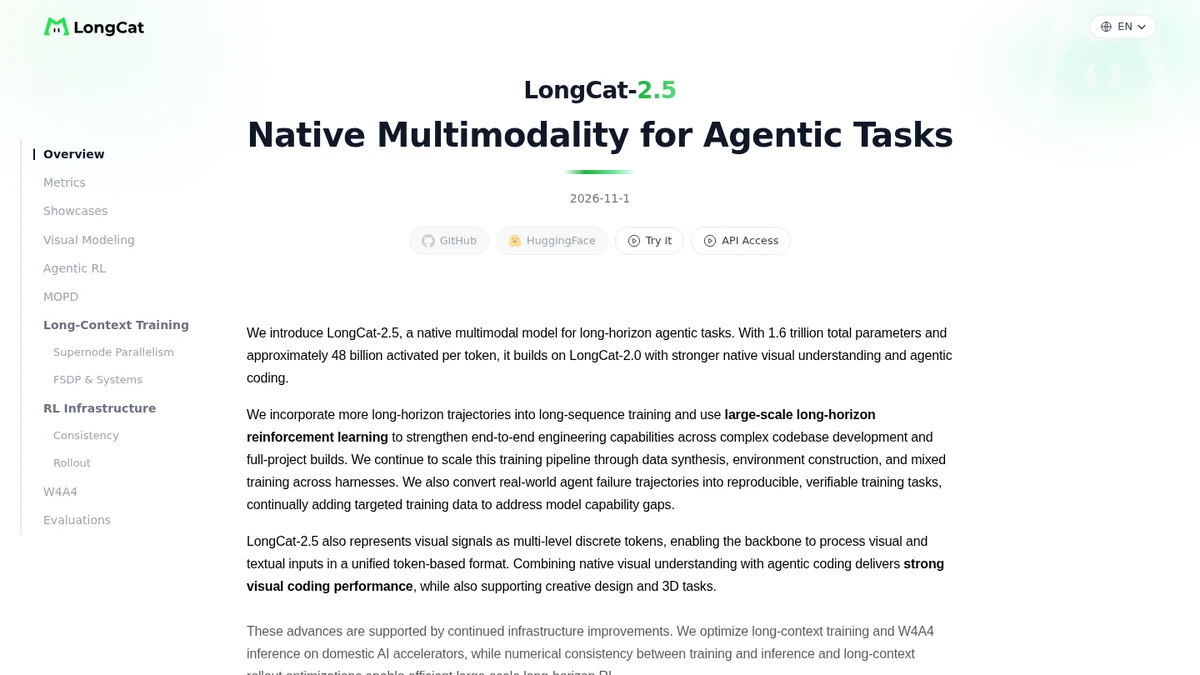
Meituan's LongCat team published the technical introduction to LongCat-2.5 on November 1, followed by a November 2 Meituan newsroom announcement of the new generation. The model is aimed at agents that must work through long sequences of actions rather than only answer short questions. It handles visual and textual information natively and is positioned for complex codebase changes and full-project software development.
The company describes a mixture-of-experts architecture containing 1.6 trillion total parameters, of which approximately 48 billion are activated for a token. Total parameter count is therefore not the same as the computation used for every generated token. Meituan says the generation adds longer task trajectories, reinforcement learning over extended workflows and training examples derived from real agent failures.
A major part of the announcement concerns computing independence. Meituan says it trained the new model entirely on Chinese-made accelerators and optimized inference for that hardware. The company frames this as evidence that domestic chips and software can support frontier-scale model development, although it has not supplied independently audited cost, energy or hardware utilization figures.
LongCat-2.5 follows the LongCat-2.0 generation released in June and a 2.5 preview made available in September. The November announcement should be read as a new model-generation and availability update, not as the first appearance of every underlying capability. Meituan's own comparisons place it near some leading proprietary systems on selected benchmarks, but those are developer-reported measurements with choices of prompts, tools and test conditions that may affect the result.
For developers, the practical question is whether the model can reliably complete extended tasks, recover from mistakes and operate at useful cost on locally available hardware. Meituan's announcement provides an important new entrant in that contest, but independent testing, access conditions and any eventual open-weight release should be evaluated separately from its launch claims.