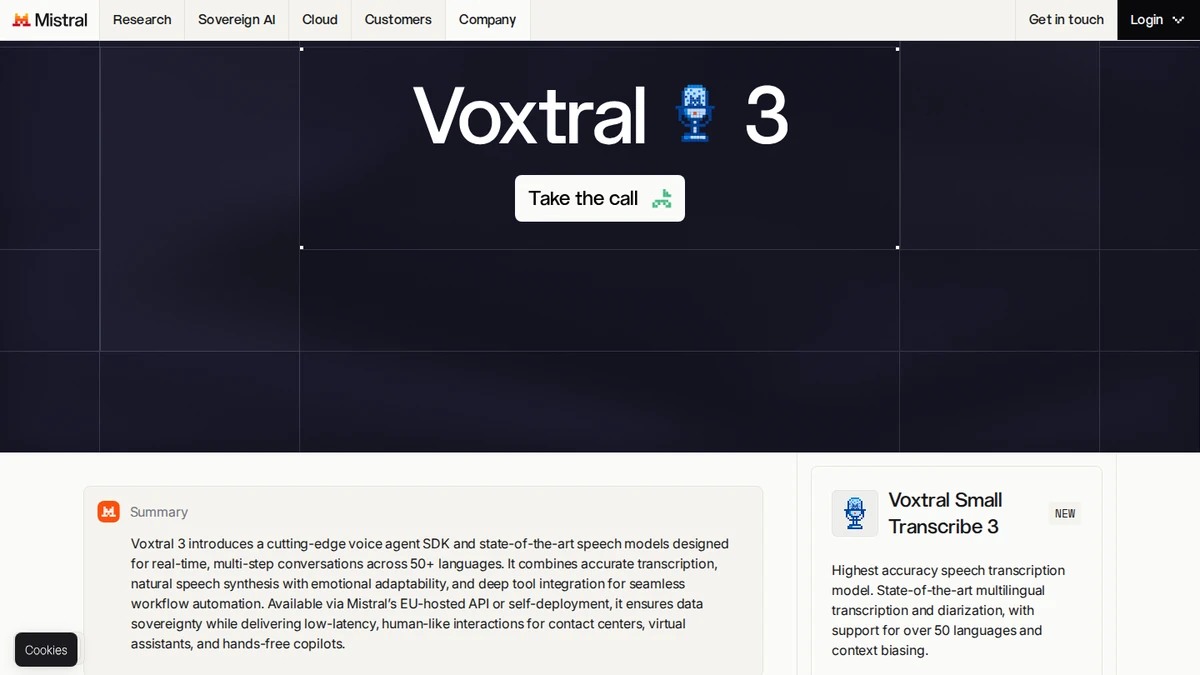
Mistral introduced Voxtral 3 on October 20, adding a new family of speech-to-text and text-to-speech models and an SDK for building conversational agents. The release targets systems that must carry a conversation while consulting information or taking actions, rather than simply transcribing a recording.
A voice stack with deployment choices
The company advertises transcription across more than 50 languages and speech generation across more than 35 languages and 50 dialects. Its streaming SDK connects separate listening, reasoning, tool-calling and speaking components. That separation gives developers a route to change the reasoning model or voice without replacing the whole application.
Mistral offers an EU-hosted API and says customers can arrange deployment on their own infrastructure. The launch lists Mini batch transcription at $0.0035 a minute and speech generation at $13 per million characters. These are advertised service prices, rather than a measured total cost for an operational call center.
The feature matrix matters
The current speech documentation narrows the practical picture. Real-time speaker diarization and end-of-turn detection cannot be enabled together in one session. Word-level timestamps are not supported, while offline transcription offers segment-level timestamps. Those distinctions affect applications that need to align a transcript precisely or identify speakers while responding immediately.
The text-to-speech documentation also distinguishes supported inline controls from broader natural-language style instructions that are unavailable at launch. Teams should assess the precise API mode they intend to use instead of assuming that every demonstration feature works in every configuration.
For organizations deploying voice agents, the material change is a more integrated, multilingual route from spoken input to an action and a spoken response. Whether it improves accuracy, interruption handling or operating cost on a particular workload still requires testing with that organization's accents, vocabulary and approval rules.