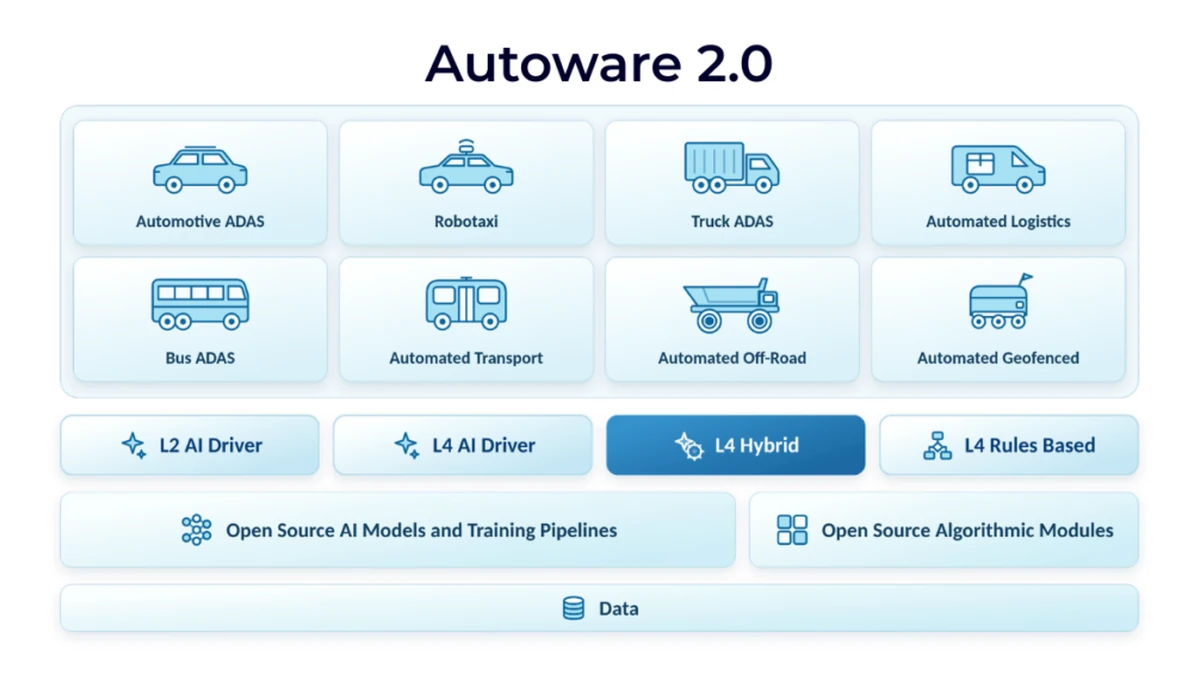
The Autoware Foundation released Autoware 2.0 on November 2, expanding the open-source driving platform to support end-to-end AI models alongside its established rule-based robotics modules. The release is not a replacement for the older sensing, localization, perception and control pipeline. It is an attempt to make different approaches coexist in a single system that developers can configure and evaluate.
A new generator-selector planning architecture lets several trajectory generators run in parallel while a selector chooses which output to use. One generator might follow explicit rules, another a learned end-to-end model and a third a hybrid approach. This is important because vehicle teams need a way to compare learned driving behavior with conventional software without rewriting their entire stack.
Autoware 2.0 also changes how models and datasets are managed. The foundation identifies Hugging Face as a default distribution home, while allowing other artifact servers. Autoware Index is a registry and command-line tool for finding compatible packages and composing workspaces, so developers can assemble a system from maintained components instead of copying a fixed repository snapshot.
The new Reference Design framework combines a deployment profile, describing vehicle hardware and operating conditions, with a documented reference software stack. Initial application families include low-speed shuttles, highway assistance and urban robotaxis. A reference design is an engineering blueprint and evaluation baseline, not evidence that a particular vehicle has achieved regulatory approval or safe driverless operation.
The release matters to the broader autonomous-driving field because it lowers the barrier to testing AI planners in reproducible, open configurations. Actual safety still depends on sensors, operational design domain, testing, redundancy and deployment oversight. The foundation has published a usable software release and architecture; production-grade reliability and any Level 4 capability must be established by vehicle-specific evidence.