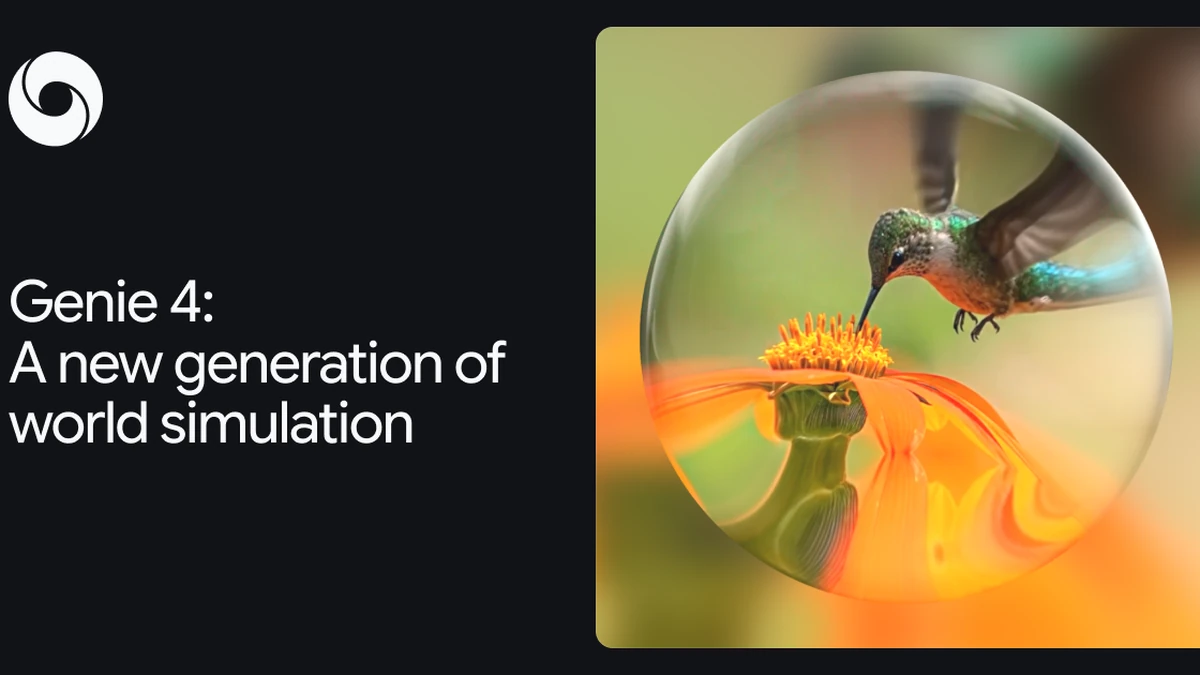
Google DeepMind announced Genie 4 on October 27 as a new generation of its world-model research. The system generates a navigable scene in real time and produces visual motion, music-like audio, ambient sound and dialogue together, rather than treating sound as a separate post-production layer.
A world model designed to react while it runs
The company says users can alter weather, camera position, characters or objects with natural-language instructions while a simulation is running. Gemini Omni helps anchor appearance and behavior, while other Gemini models supply reasoning intended to preserve coherence as the scene evolves.
That combination matters beyond entertainment. DeepMind presents variable interactive worlds as potential training environments for robots and agents, where systems can encounter many safe, repeatable scenarios without requiring every situation to be staged in the physical world.
A significant launch with deliberately limited access
Genie 4 is not a generally available consumer or developer product. DeepMind says it has begun a research preview with trusted testers and plans to start with Google AI Ultra subscribers in Project Genie and early partners for the Gemini API and Google AI Studio.
The launch therefore establishes a new model generation and a clear product direction, but not yet broad availability or independently verified performance. Claims about photorealism, continuity and real-time control come from company demonstrations; outside testing will be needed to measure consistency, latency and failure modes across longer interactions.