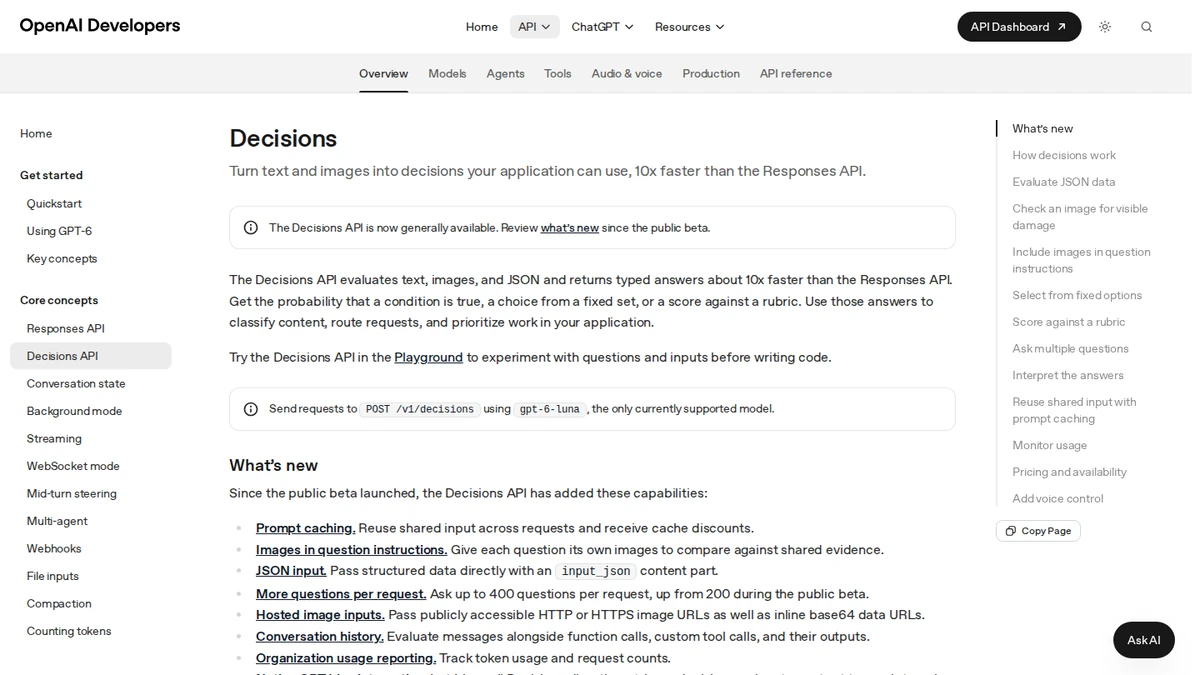
OpenAI made its Decisions API generally available on October 22, moving a specialized endpoint for repeated application decisions into production. Rather than generating an open-ended answer, the API is designed to return a constrained probability, label, score or choice that software can use directly.
A narrower interface for repeated decisions
The release targets workloads such as ranking, moderation, routing and personalization, where an application asks the same structured question many times. OpenAI says developers can provide text, images or JSON and define as many as 400 questions in one request. The documentation also describes prompt caching and US or EU data-residency options.
OpenAI says the endpoint is built on GPT-6 Luna and can be up to ten times faster than using the Responses API for comparable tasks. That is a vendor claim, not an independently reproduced benchmark, and it does not establish accuracy, reliability or total cost for a specific production workflow.
Why the boundary matters
A bounded result can reduce the parsing and validation work required when a model sits inside an automated system. It also makes the requested output easier to audit than free-form prose, although the application still needs thresholds, fallback behavior and human review for consequential decisions.
The general-availability milestone matters because it gives developers a supported production route for a common class of model-assisted judgments. Adoption will depend on whether teams can reproduce the promised latency while maintaining calibration and error rates on their own data.