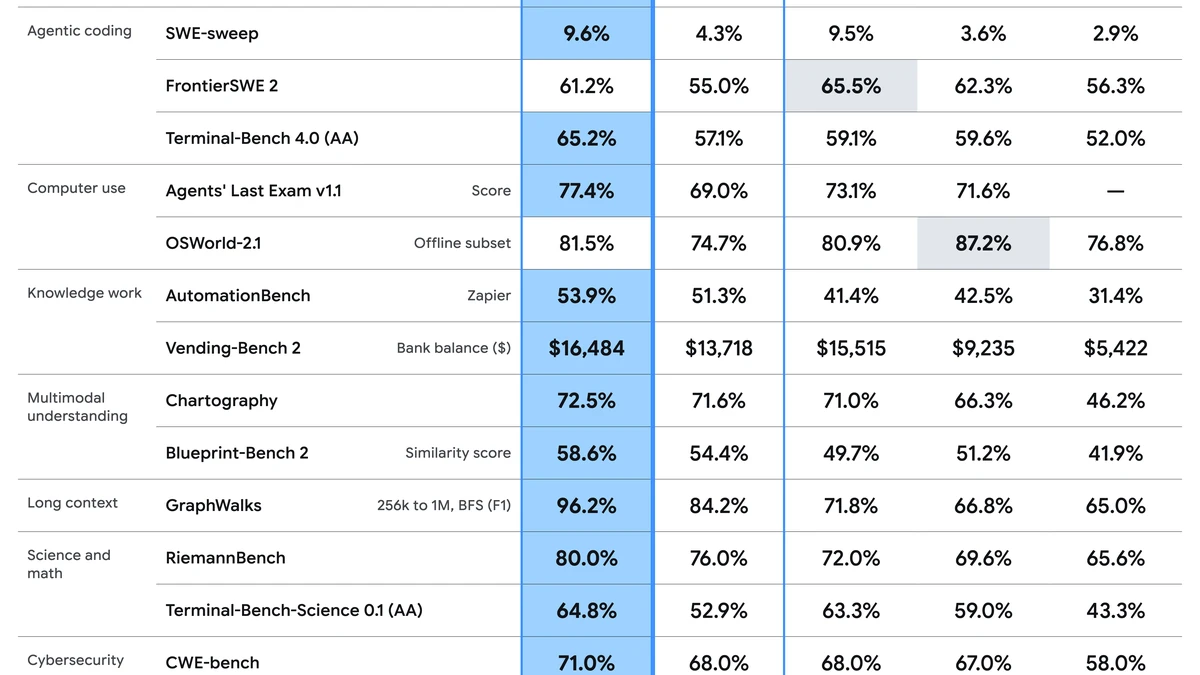
Google announced Gemini 4 Carbon on October 28, describing it as its strongest frontier model and beginning a controlled rollout to a subset of cyber defenders. The release is a significant new model announcement, but it does not mean the model is already generally available in Gemini or through every developer product.
The company says Carbon improves sustained software engineering and cybersecurity work over Gemini 4 Argon. Its announcement reports scores of 88.2% on SEC-bench Pro, 54.8% on ExploitGym and 71.0% on CWE-bench. Those measurements cover different tasks—finding vulnerabilities, testing exploitability and producing patches—and should not be combined into a single measure of real-world security.
Google says its own teams have used Carbon on engineering tasks lasting days. That is a vendor account of internal use, rather than independent evidence that an unsupervised agent can safely complete arbitrary long projects.
The initial access route is Google's Fairwind Program for trusted partners, alongside voluntary U.S. government pre-release testing. Google says it is collecting feedback and improving safeguards before broader developer, business and consumer availability. Its announced introductory API price is $2 per million input tokens and $10 per million output tokens; the announcement is not evidence that every customer can buy access today.
The practical change is a stronger claimed capability entering a narrower deployment channel. Buyers and defenders will need to evaluate the released service, its guardrails and task-specific reliability rather than treating a vendor benchmark table as a guarantee. Google CEO Sundar Pichai separately confirmed the defender-first rollout in the company's earnings remarks.