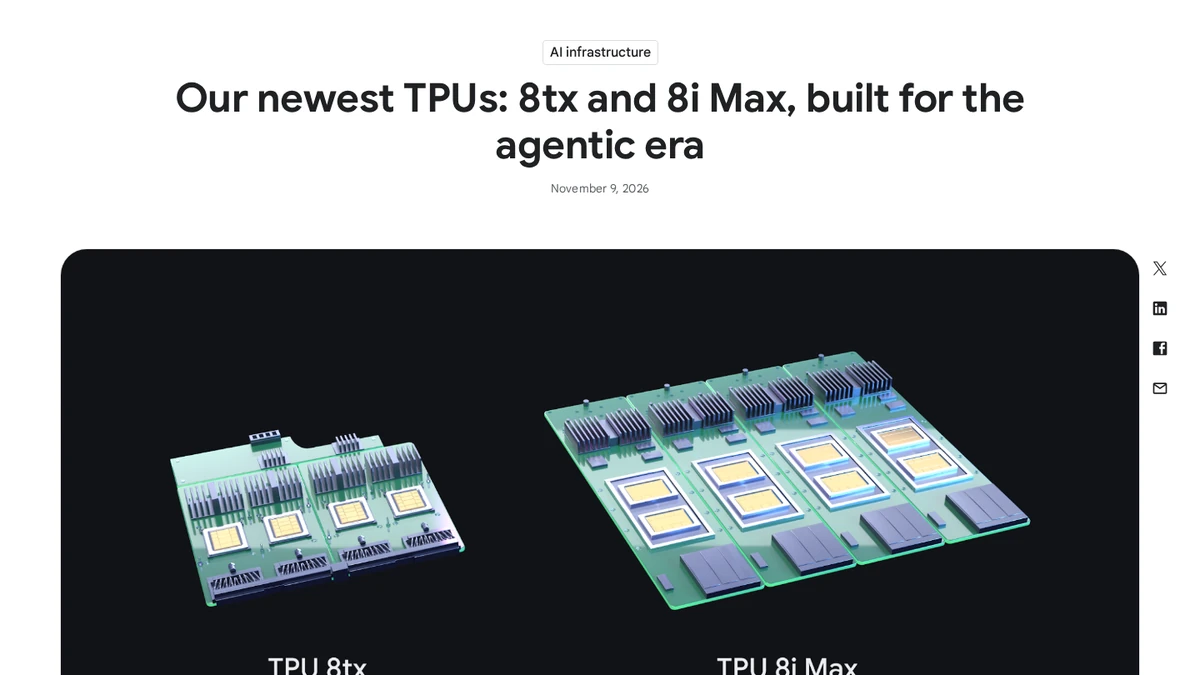
Google introduced TPU 8tx and TPU 8i Max on November 9, expanding its in-house AI accelerator lineup beyond the previously announced 8t training and 8i reasoning configurations. The announcement targets customers whose workloads cannot be optimized solely for maximum training throughput, including regulated organizations and applications that process unusually large contexts.
The 8tx is designed for confidential computing in regulated environments, combining Google TPU technology with AMD processors and hardware-backed protections. Google describes performance improvements over the previous generation, but the claims depend on Google's workload and comparison methodology. Customers must still evaluate security boundaries and actual throughput for their deployment.
The 8i Max takes a different route, packaging additional compute and memory capacity for workloads that need larger working sets, including complex reasoning, coding and scientific applications. This reflects the increasing importance of memory bandwidth and capacity alongside raw arithmetic throughput as AI systems process larger inputs and intermediate state.
Google says its TPU business serves nearly 100 customers, including frontier AI labs and enterprises, and that it is extending options for cloud use and on-premises deployment. The announcement does not establish that every TPU configuration is immediately available to every customer, nor does it quantify customer purchases from the new variants.
The strategic implication is a more segmented accelerator market. Nvidia remains a major platform provider, but cloud operators are tailoring silicon to security, inference memory and specific application economics. Buyers should compare total cost of ownership, portability and availability rather than assume a single headline performance claim predicts deployment results.