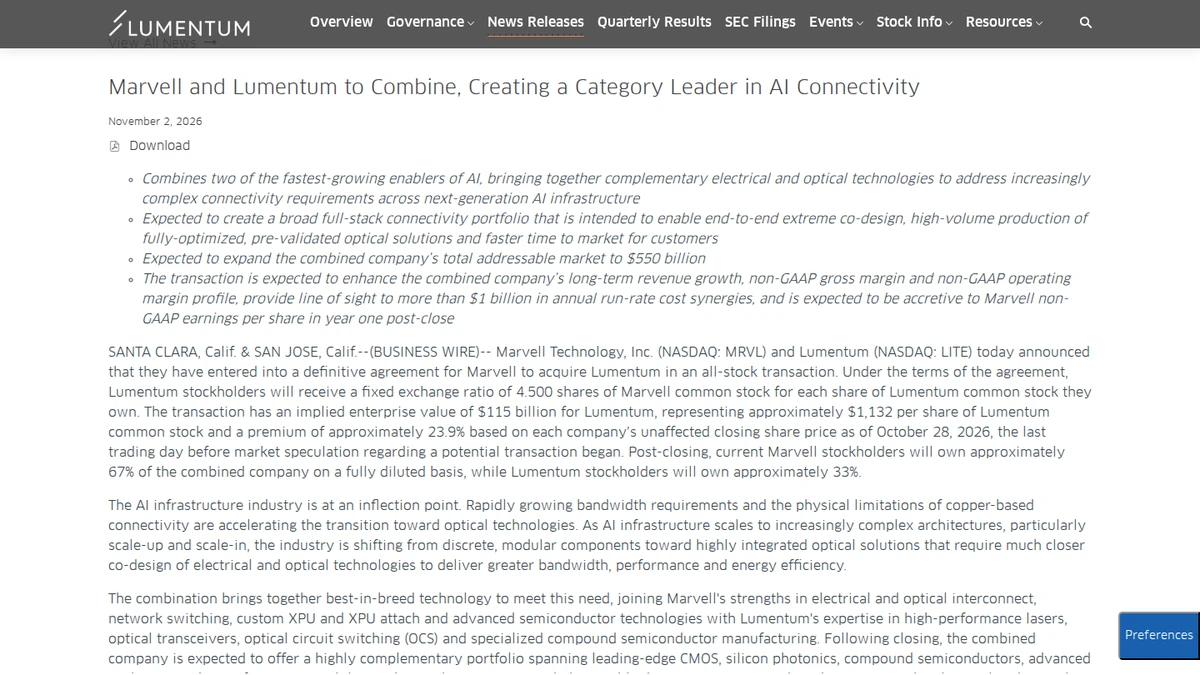
Marvell Technology and Lumentum announced a definitive agreement on November 2 to combine in an all-stock transaction, one of the largest proposed deals tied to the infrastructure behind artificial intelligence. The announced implied enterprise value for Lumentum is about $115 billion, not cash being paid to its shareholders. Under the terms, Lumentum investors would receive 4.5 Marvell shares for each Lumentum share they own.
The companies say current Marvell shareholders would own roughly 67% of the combined business and Lumentum shareholders about 33% on a fully diluted basis. Both boards have approved the agreement, but that is not the same as closing. Shareholder votes, regulatory clearances and customary conditions remain outstanding; management currently expects completion in the first half of calendar 2028.
The industrial logic is that data centers are running into bandwidth and power limits as AI clusters scale. Marvell designs custom accelerators, switching and electrical and optical interconnect chips. Lumentum supplies lasers, optical transceivers, optical-circuit switching and compound-semiconductor manufacturing. Putting those capabilities together could help suppliers co-design the complete path carrying data between processors and racks rather than optimizing isolated components.
Marvell and Lumentum project a combined addressable market of $550 billion and a path to more than $1 billion of annual run-rate cost synergies. Those are management estimates about future markets and integration, not realized revenue or savings. The companies also describe possible improvements to growth, margins and post-close earnings per share; the eventual economics will depend on demand, execution and the price paid.
The agreement makes optical connectivity a central strategic battleground in AI infrastructure. Yet the unusually long projected closing horizon creates substantial uncertainty: regulators may scrutinize the combination, rivals can respond and customers may alter their architecture before integration begins. Until the approvals are secured, the companies remain separate businesses and the transaction is proposed rather than completed.