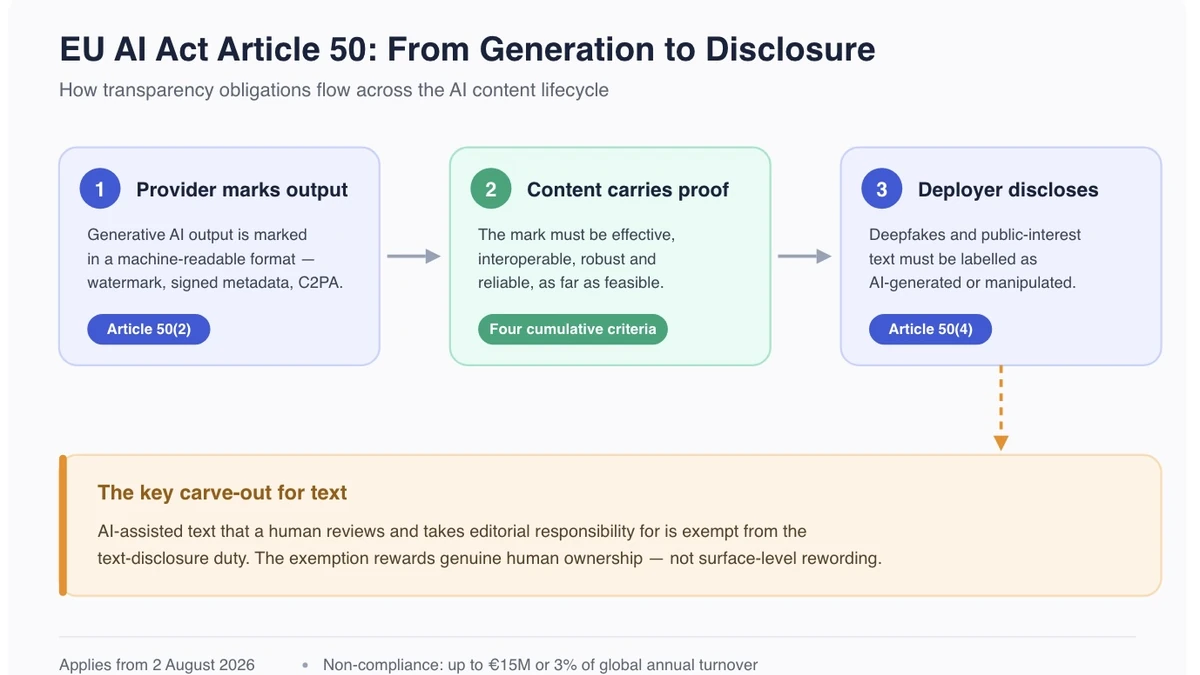
OpenAI announced October 5 that API customers can opt in to text watermarking for select models worldwide, while eligible ChatGPT and Codex text output in the European Union will receive invisible watermarks over the coming weeks.
A phased response to EU provenance requirements
The company says its textGrain system changes model word choices to embed a statistical signal. Detector access is initially limited to approved researchers and expert organizations, and OpenAI says it intends to open-source the technology later.
OpenAI also emphasizes limits: short or constrained text is harder to detect, and editing or translation can weaken the signal. Its detection and benchmark figures are internal evaluations, not independent guarantees that a passage is AI-generated or human-written.