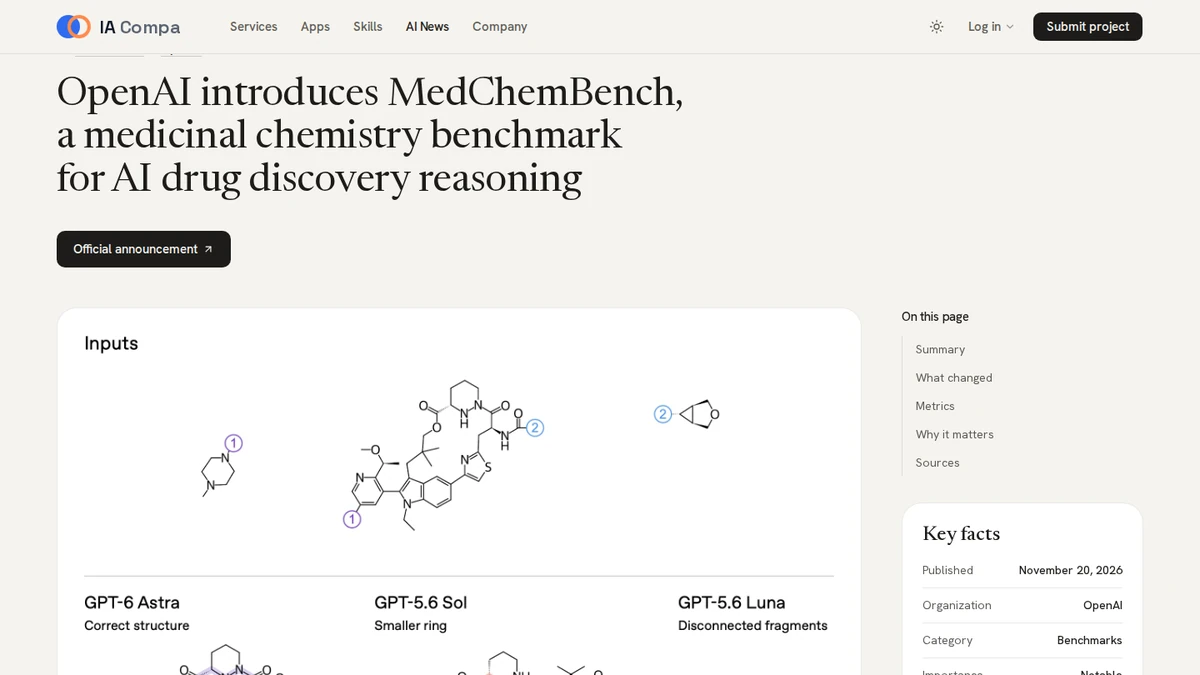
OpenAI introduced MedChemBench on November 20 to evaluate whether language models can interpret molecular structures, reason from experimental findings and prioritize compounds in medicinal-chemistry tasks. The benchmark comprises 99 problems drawn from 117 published papers and patents and 761 distinct molecular structures.
In the company's reported xhigh evaluation, GPT-6.2 Astra earned 84.5% of available credit, compared with 83.3% for GPT-6 Astra and 82.0% for GPT-6.1 Sol. These are results on OpenAI's selected retrospective tasks, not measured clinical outcomes or proof of autonomous drug discovery.
The test separates structural reconstruction, scientific reasoning, compound ranking and property prediction. OpenAI reports that model performance remains notably weaker on selecting compounds and predicting quantitative properties than on interpreting molecular structures.
Because source publications may have appeared in model training data, prior exposure cannot be excluded. The benchmark uses one-shot responses without laboratory experiments, tools or iterative feedback; it is useful for measuring a research bottleneck but cannot establish real-world medicinal-chemistry effectiveness.