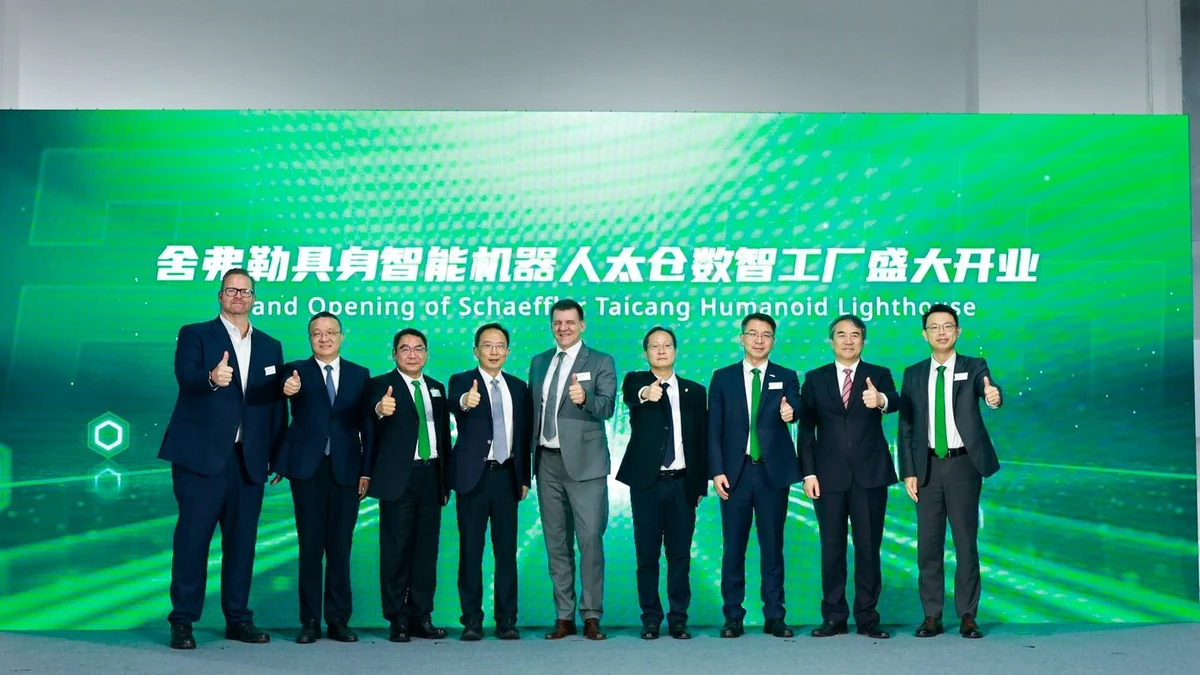
Schaeffler opened a factory in Taicang, China, on October 20 that combines production of humanoid-robot components with training and data collection for robots working on the line. The company describes the 7,500-square-meter site as a lighthouse factory for its industrial approach.
According to Schaeffler, six humanoids operate across five stations, helping produce joint modules and linear and rotary actuators. These components provide movement in a robot, making the site an example of automation entering the supply chain for automation itself.
Production and learning in one facility
The factory brings component manufacturing together with training, operational data collection and a digital-twin environment. That arrangement gives the company a place to observe the relationship between a robot's behavior and the manufacturing process around it.
Gasgoo separately reported the opening and the integrated production-and-training design. The evidence establishes a specific facility and the company's stated deployment, rather than proof that humanoids have become a general replacement for industrial automation.
Schaeffler says mass production has begun and cites roughly €400 million in incoming orders globally for its humanoid-related business. Orders indicate customer commitments as reported by the company; they are not the same as completed shipments, recognized revenue or profit from this factory.
What remains to be demonstrated
The important next measures are sustained output, reliability, maintenance needs and performance against alternative ways of doing the same work. The opening announcement does not provide enough independent operational data to establish those economics.
The site is nevertheless a material step beyond a stand-alone demonstration: Schaeffler has identified a factory, a component-production role and a training environment in which the robots will be used. The opening photograph accompanying this report depicts that facility's event, not a generated image of a hypothetical robot line.