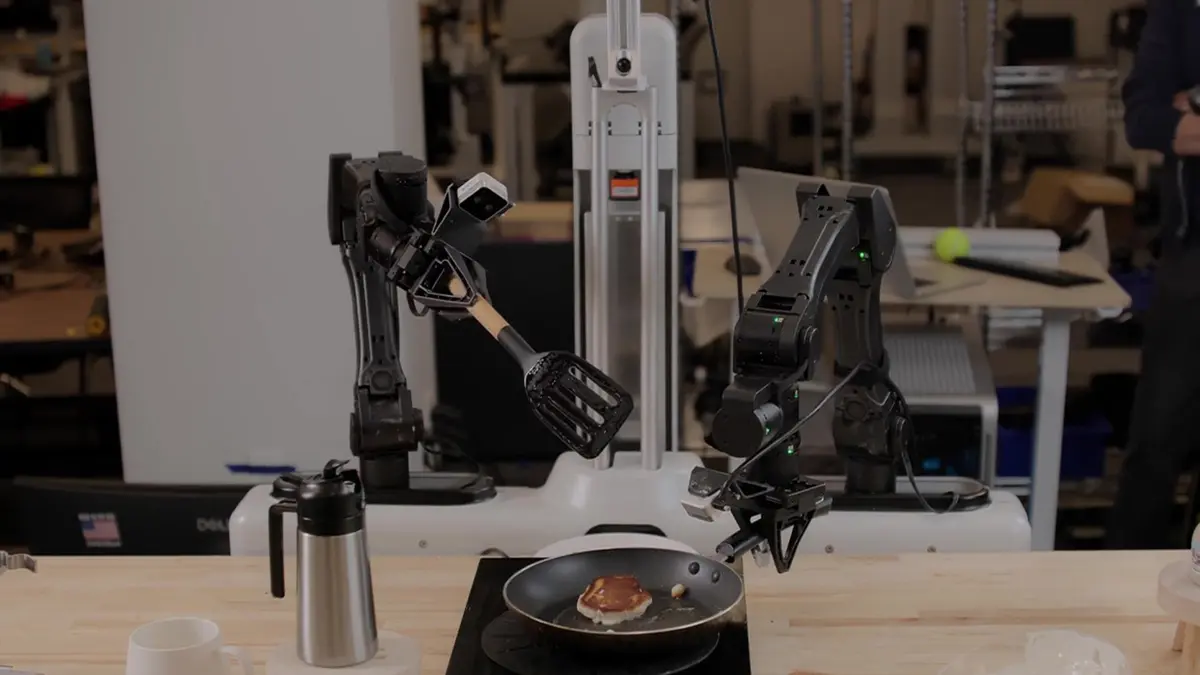
Skild AI has published results for S1, its robotic foundation model designed to learn a task from a single video demonstration. Instead of translating a short language instruction into a fixed action sequence, S1 treats the demonstration itself as context and maps the observed intent, objects, and order of operations onto the robot in front of it.
A video becomes the robot's prompt
Skild says the same model weights produced all of the examples in its release, without task-specific fine-tuning or post-training. The demonstrations include plant potting, pancake cooking, pour-over coffee, and kit assembly. Some run for as long as 10 minutes and require dozens of manipulation steps that the company says were absent from the pretraining task set.
The approach is a robotics version of in-context learning: pretraining teaches the policy to infer a task from context, while the video specifies what to do at execution time. This could shorten the conventional deployment loop in which teams collect teleoperation data, fine-tune a specialist policy, and validate it whenever a process or factory layout changes.
Promising internal results, with important limits
On an internal suite of unseen, four-to-eight-minute tasks, Skild reports a 66% cumulative per-step success rate for its in-context policy at 100,000 hours of pretraining data, compared with 9% for a language-conditioned vision-language-action baseline trained with the same data and compute. It estimates that one video demonstration delivered performance comparable to roughly 380 task-specific teleoperation examples.
Those numbers are not a field-wide leaderboard. Skild designed the evaluation, chose the task suite, and reports the results itself. Human intervention was used to recover from failures so every step could be graded, especially because the baseline otherwise failed to finish the unseen long task. The comparison is therefore evidence for the company's research claim, not independent proof that S1 generalizes across arbitrary robots or workplaces.
From simulation to factory deployment
NVIDIA says Skild trained and validated S1 using its accelerated computing, Cosmos models, Omniverse libraries, Isaac Sim, and Isaac Lab. The companies are also working on simulation solvers for contact and manipulation. Skild, NVIDIA, and Foxconn have demonstrated a dual-arm workflow that installs parts and fastens 16 screws during Blackwell-system assembly.
The larger test is repeatability outside curated demonstrations. A useful general robot policy must cope with unfamiliar objects, lighting, wear, safety constraints, and the cost of failures over thousands of cycles. S1's release makes a substantive case for video-prompted adaptation, but independent evaluations and production reliability data will determine whether that promise survives real operating conditions.