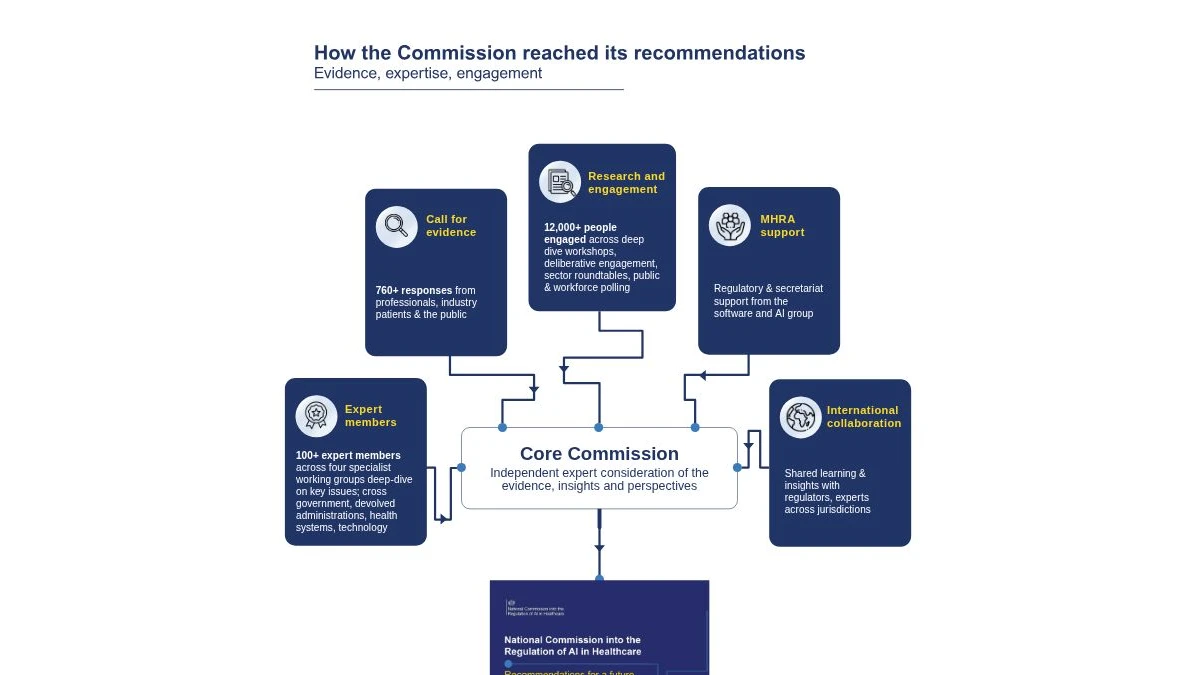
The United Kingdom’s National Commission into the Regulation of AI in Healthcare published 44 recommendations on September 10 for a future regulatory and assurance framework. The commission was established and supported by the Medicines and Healthcare products Regulatory Agency, but developed its advice independently. The report is advisory: a separate cross-government response is still to come.
From one-time approval to lifecycle oversight
The commission’s central conclusion is that AI-health regulation should become proportionate, lifecycle-based and system-wide. It argues that one-off pre-market assessment is insufficient for products that can change over time or behave differently across care settings. The proposed framework would use clearer risk classification, staged routes to market, real-world evidence, post-market monitoring, sandboxes, and stronger enforcement where needed.
Responsibility beyond the product maker
A second group of recommendations assigns roles across manufacturers, healthcare providers, professionals, regulators and policymakers. The report calls for an AI-readiness toolkit, clearer lifecycle responsibilities and liability arrangements, governance for deployment and monitoring, workforce training, and procurement controls. A third group focuses on patient transparency, public participation, safety reporting, and predictable early engagement with regulators.
The recommendations also ask government and health bodies to consider vendor-independent comparative testing, formal regulatory-classification confirmation, and clearer rules separating research from routine post-market evaluation. CMS’s independent legal analysis characterized the package as a shift from pre-market controls toward lifecycle regulation and highlighted conflicting stakeholder views about whether today’s framework is too loose or too restrictive.
No statute or binding medical-device rule changed when the report was published. Implementation, sequencing, funding, and any changes to the UK Medical Devices Regulations depend on the forthcoming government response and subsequent regulatory work. The recommendations therefore establish a policy direction, not an operative approval pathway.