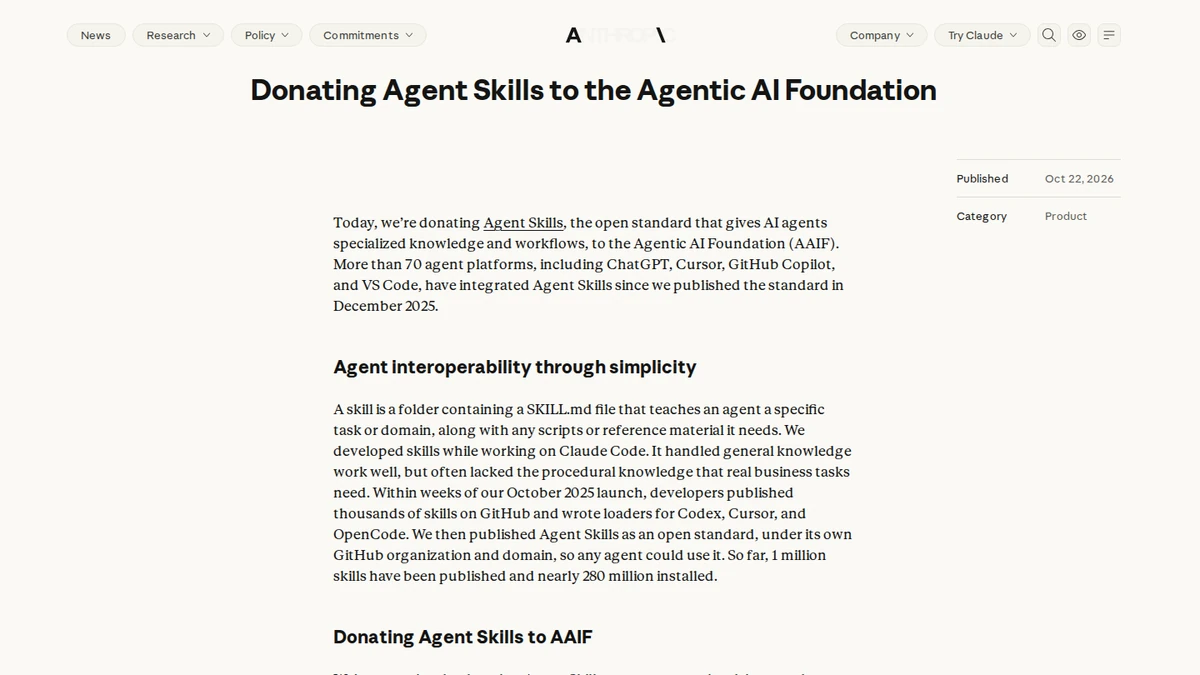
Anthropic said on October 22 that it is donating Agent Skills to the Agentic AI Foundation, placing the specification under the Linux Foundation's agent-standards initiative. The transfer changes governance of a format that packages instructions, scripts and supporting resources for an AI agent to use when it needs a particular capability.
From vendor format to shared governance
The company says Agent Skills is already supported by more than 70 platforms. It also reports more than one million skills and 280 million installations in its ecosystem. Those figures are Anthropic's measurements and were not independently audited by Signal.
Under the announced structure, maintainers will continue technical work through the Agentic AI Foundation, with a public roadmap and community contribution process. Anthropic also says the project will develop guidance for security, discovery and interoperability.
Why a packaging standard matters
Agents need more than model weights: they need a repeatable way to acquire domain instructions and executable tools. A portable package can reduce the work required to move a capability among agent systems, while foundation governance can make one vendor's implementation choices easier for competitors and users to influence.
Governance does not remove the security risk of loading third-party instructions or scripts. Platform operators still need provenance, permission boundaries, review and revocation controls. The material development is the institutional transfer; the standard's long-term interoperability and security outcomes remain to be demonstrated.