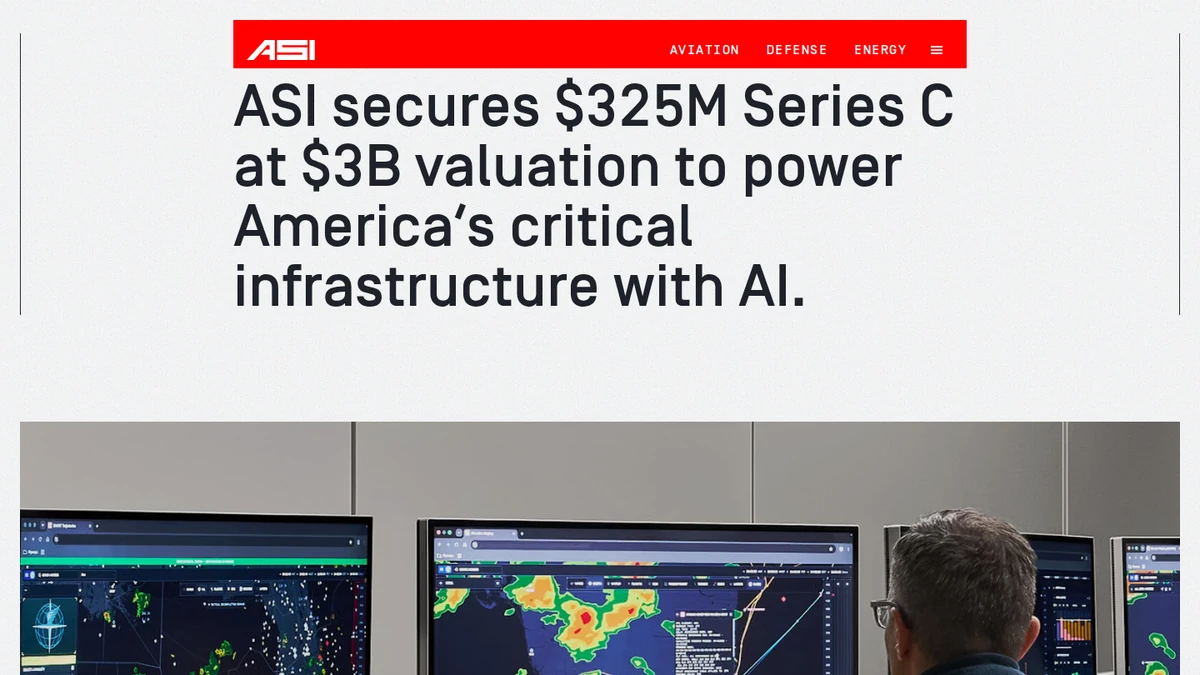
ASI announced a $325 million Series C on October 20, valuing the critical-infrastructure AI company at $3 billion. Spark Capital led the financing, with participation from affiliates of Citadel Securities, Meritech Capital, Craft Ventures, Energy Impact Partners and Andreessen Horowitz.
Reuters separately reported the round and valuation. The $325 million is the announced financing amount; the $3 billion figure is the company's valuation in the transaction. Neither number measures annual sales or money already spent on deployments.
AI beyond a chat interface
ASI describes its product as software that combines forward simulation, monitoring and optimization to help operators coordinate physical assets. Its target markets include aviation, energy, logistics and national-security operations, where the sequence and timing of decisions can matter as much as an individual prediction.
The company says the new capital will support expansion into energy, logistics and tactical-edge applications, alongside its research and engineering teams. These are intended uses of financing, rather than evidence that the proposed expansion has already been completed.
What the round establishes
The financing is significant because it backs an AI application tied to constrained physical systems. A system coordinating aircraft or grid assets must account for operational rules, uncertainty and human decision-making; a convincing language-model demonstration alone does not establish that capability.
ASI also describes major government programs and commercial deployments in its announcement. Signal has not treated the headline values of those programs as collected revenue or cash received, and has not independently audited the company's operational outcomes.
The round provides a concrete capital event for the sector. The next substantive evidence will be the scope of systems actually deployed, the terms under which operators rely on them and measured improvements against existing planning processes. Those questions remain separate from the size of the funding round.