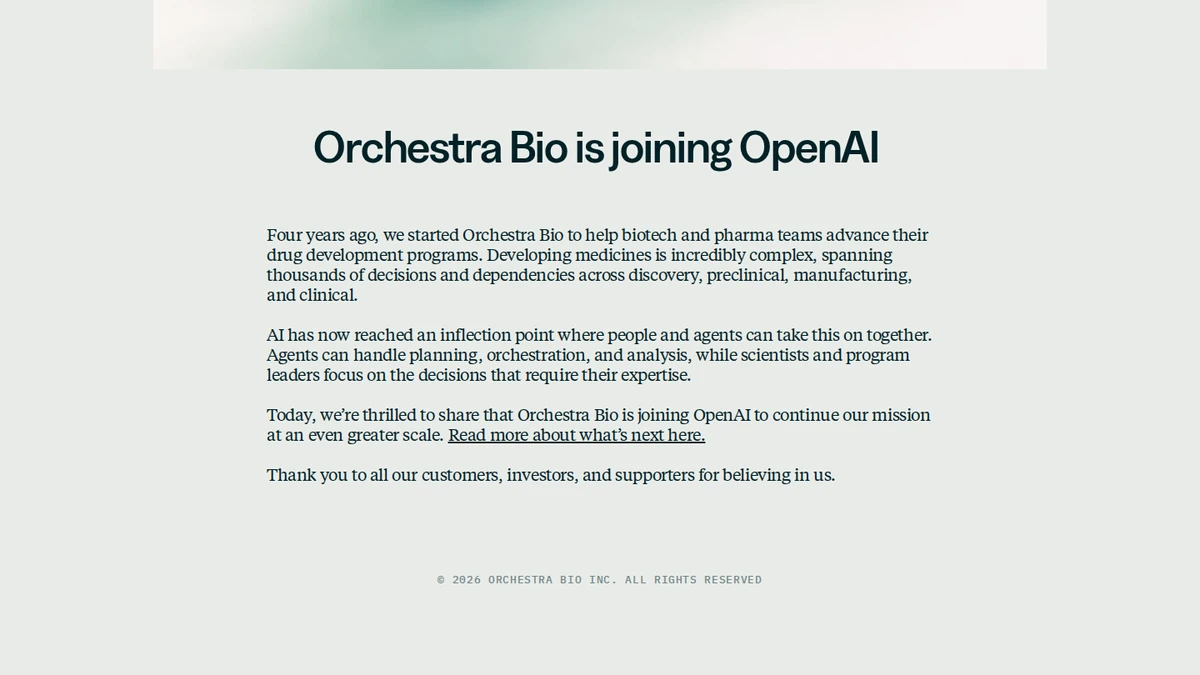
OpenAI said on October 20 that it had acquired Orchestra Bio, a company building software to coordinate drug-development programs. Orchestra's own website confirms that it is joining OpenAI. The announcement says its team and platform will become part of Rosalind.
The deal concerns the organization of scientific and development work: tracking studies, their dependencies and the decisions needed to move a program forward. It is a different kind of acquisition from buying a new foundation model or a laboratory with an approved therapy.
Coordination is part of the research problem
Drug-development programs involve interdependent evidence and decisions. A change in one study can affect what must happen next elsewhere in the program. Software that makes those relationships easier to inspect could be useful even before an AI system proposes a new experiment.
OpenAI positions Orchestra's platform as a way to bring that coordination into Rosalind. This is the announced integration direction. The sources do not establish that the combined system is already deployed across customers or has shortened a clinical trial.
The acquisition also illustrates a broader product strategy: applying general AI capabilities inside specialist workflows. For users, the consequential test is whether the software keeps evidence, decisions and accountability connected when a project changes.
Terms and outcomes remain open
The reviewed announcements do not disclose a purchase price. They therefore do not support estimates of the deal's value, a return on investment or the amount OpenAI has spent integrating the company.
Nor does acquiring planning software demonstrate that a medicine is safer, more effective or closer to approval. Those outcomes depend on experimental and clinical evidence. The confirmed news is the acquisition and the stated plan to combine the teams and technology; broader effects on drug-development speed remain prospective.