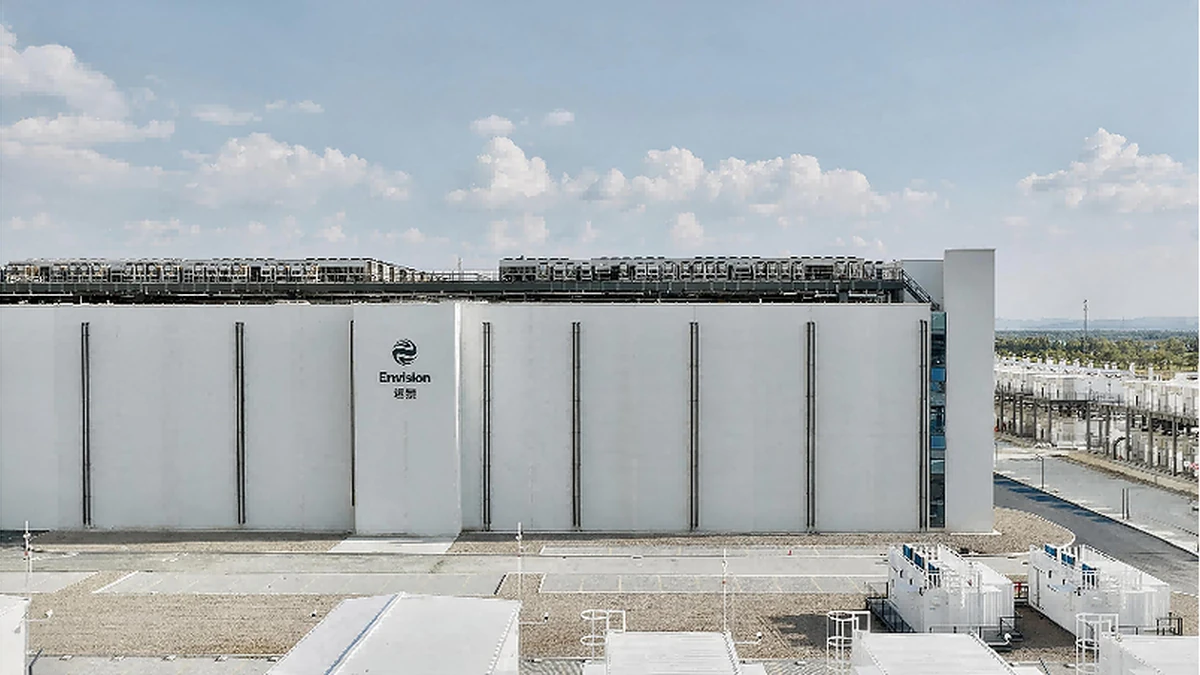
Envision announced on November 2 that an integrated 800-volt direct-current power system is operating at its Galaxy AI data center campus in Ulanqab, Inner Mongolia. The company describes the deployment as the first commercial installation of its kind at a large-scale AI facility. The announcement is about power equipment serving live computing loads, not the opening of an entirely new campus; Galaxy began operations in August.
The architecture converts medium-voltage grid input through solid-state transformers to an 800V DC bus serving computing hardware. Battery energy storage is integrated to buffer sudden load changes and provide short-duration backup. Envision says its Dubhe Controller, supported by its energy model, coordinates transformer output and storage in milliseconds as GPU demand rises and falls.
Data-center power delivery matters because modern AI racks consume far more electricity than conventional server racks. Higher-voltage DC designs can potentially reduce conversion stages, copper cabling and equipment footprint. Envision says its implementation improves efficiency and density, but the release does not provide an independently audited site-level power-usage-effectiveness result or a comparable baseline for the claimed gains.
The company says the Galaxy campus is designed for a planned 3-gigawatt capacity and up to one million AI accelerators at full build-out, with more than 80% of its power intended to come through direct renewable connections. Those are ultimate design targets rather than proof that all planned capacity, accelerators or renewable generation are currently operating. Envision also describes a 5-gigawatt global desert-region ambition by 2030 under Mission Gobi.
This deployment gives the industry a concrete commercial reference for integrating transformers, batteries and controls in a high-density AI power system. Its broader relevance will depend on measured uptime, power losses, equipment costs and replication at other campuses. For now, the strongest supported fact is Envision's issuer-reported live deployment; comparative efficiency and worldwide priority remain company claims.