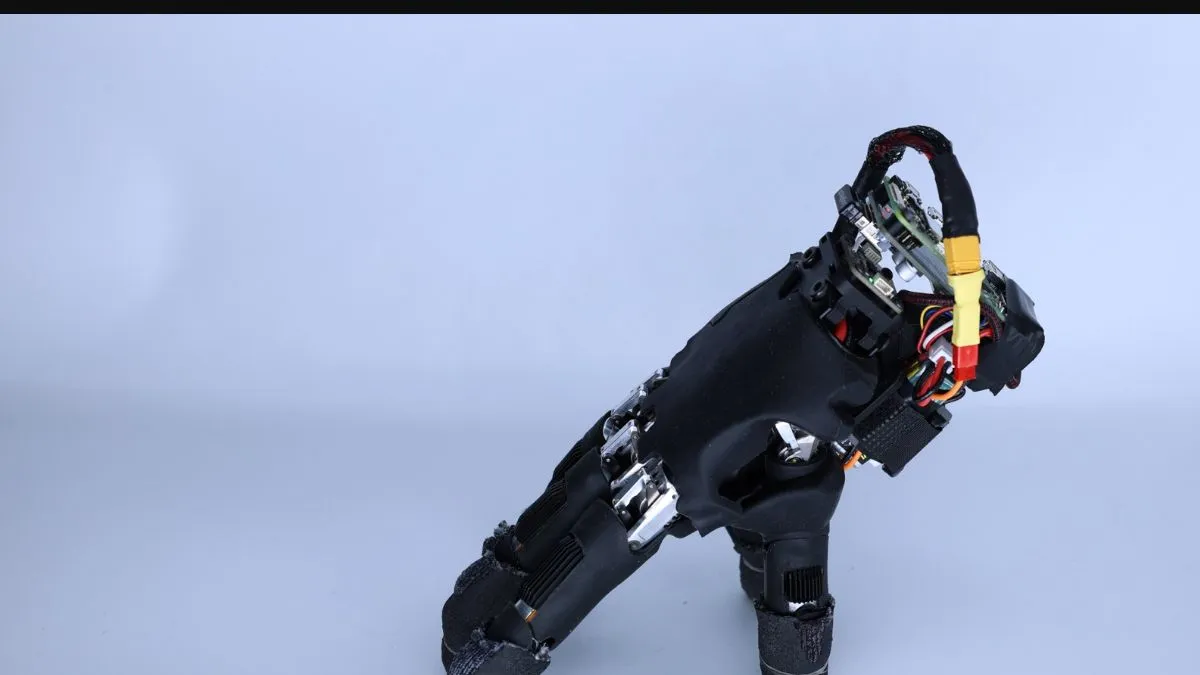
ETH Zurich’s Soft Robotics Lab presents a five-fingered robotic hand that can use its fingers as legs. The project combines onboard actuation, sensing and control so the hand can crawl, recover from a fall and interact with objects without being mounted on a conventional arm.
A hand that changes its support points
The project page reports trials on 14 different surfaces, including behaviors in which the hand walks on its fingertips, recovers after tipping and pushes an object. A keyboard interaction test is also used to show that the hand can move its support and contact points with enough control for discrete touches.
The reported numbers are laboratory results
ETH’s project materials report recovery in 21 of 25 tested falls and successful keyboard presses in 29 of 32 attempts. Those figures describe the disclosed experiments, not a general-purpose robot or a demonstrated route to deployment outside the lab.
Why the result is still bounded
The accompanying preprint describes separate learned behaviors and a specific hardware and evaluation setup. No independent replication was located for this edition, so the results should be read as a research demonstration rather than evidence of broad transfer across hands, surfaces or tasks.