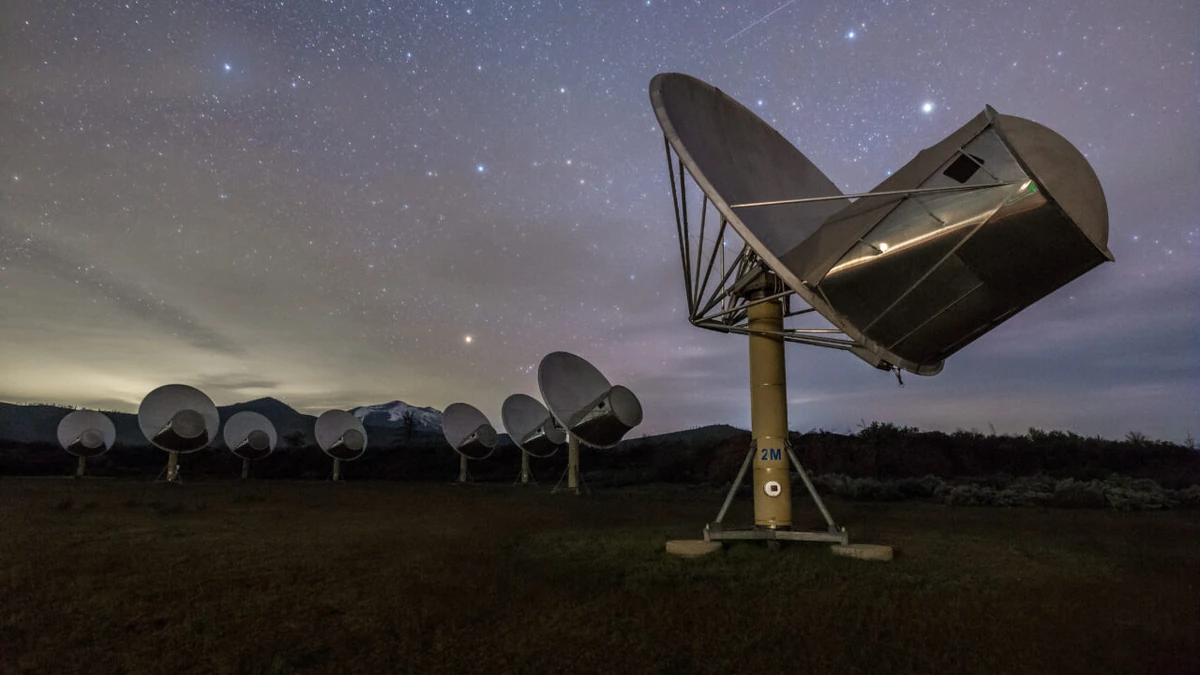
Researchers at the Allen Telescope Array are integrating AI agents with observing and signal-processing workflows, according to an October 30 NVIDIA report. The system links natural-language requests to instrument control and live analysis, making it an applied scientific infrastructure story rather than a discovery of an extraterrestrial signal.
NVIDIA describes DAQIRI moving sensor data into GPU memory, CyberEther handling signal processing and Nexus coordinating instrument state and compute resources. The company reports processing capacity of 2.4 terabits per second on RTX PRO 6000 Blackwell GPUs, with inference near the instrument.
The report also describes a real-time AI detection of a pulsar in the Crab Nebula. That is an account of a known astronomical class of object, not a claim that the system has found alien technology.
These are vendor-reported capabilities and demonstrations. Independent scientific validation and operational reliability remain distinct questions; claims about dramatically compressing research work should not be read as a measured guarantee for every observing task.
The practical significance is the connection between agents and a physical scientific instrument. The publication uses a real photograph of the array as facility context, with its older capture date acknowledged in the image metadata. It does not portray the photograph as a new observation result.