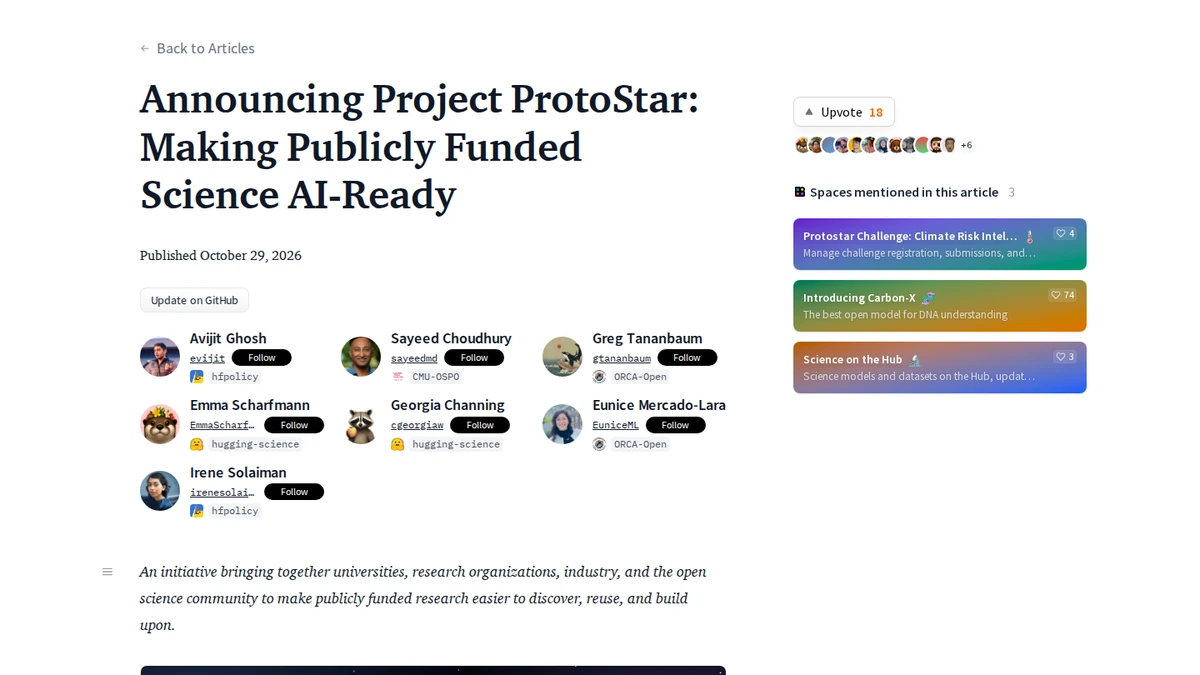
Hugging Face and a group of research institutions announced Project ProtoStar on October 29 to make publicly funded scientific datasets, models and code easier to discover and reuse. The effort focuses on usable research infrastructure rather than releasing a new frontier model or claiming a completed scientific breakthrough.
Founding participants include Carnegie Mellon, Purdue, Georgia Tech, Arizona State and George Washington universities, alongside Astera, Hugging Face and the Open Research Community Accelerator. The organizers plan institutional sharing commitments and a sequence of open challenges.
The first challenge, hosted by Carnegie Mellon, is scheduled for November 2–13. Participants will use historical weather records from 210 U.S. cities to predict later observed conditions, including temperature, precipitation, extreme heat and cooling demand. The organizers plan to compare forecasts with simple statistical baselines.
That comparison is important because making data accessible and applying AI are not the same as demonstrating improvement. A public challenge can expose documentation gaps, incompatible formats and weak evaluation methods as well as promising model performance.
The announcement's benefit is therefore prospective: better organized scientific artifacts could lower barriers to reuse across institutions and disciplines. Final results and evidence of improvement remain to come. Readers should distinguish the launch of the initiative and challenge from established findings about AI's effectiveness in climate prediction.