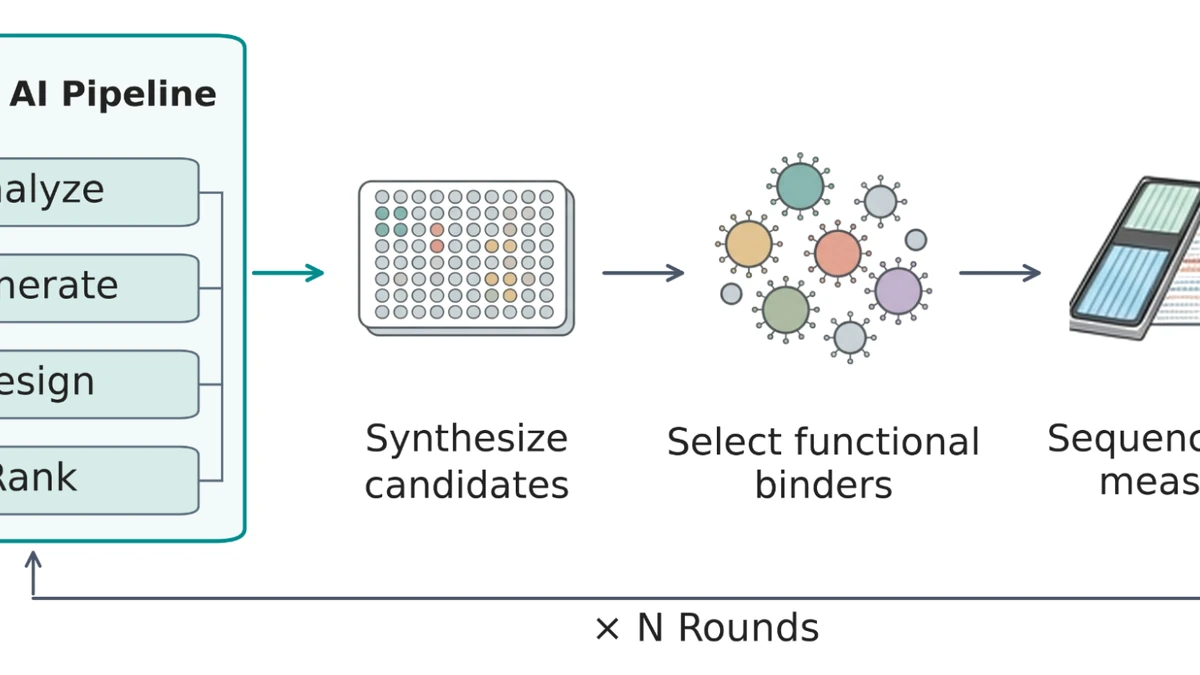
Google Research described an experimental loop in which AI agents propose biological candidates, laboratory teams synthesize and test them, and the results guide another design round. The October 16 post frames the work as a foundation for more autonomous wet-lab research, not as an unattended facility.
The researchers report three rounds of experiments involving protein targets including myoglobin, alpha-thrombin and fibroblast activation protein (FAP). For FAP, Google says the resulting aptamer binders reached single-digit nanomolar affinity, a measurement of binding strength.
The result is notable because the model-assisted workflow is connected to physical synthesis and testing rather than stopping at computational predictions. Yet the public write-up is an early project report: it does not establish independent replication, general success across biology, or a validated system that can operate without scientific oversight.
The broader implication is a research method that may shorten cycles between hypotheses and experiments. The reported outcomes and their significance remain Google’s account; readers should distinguish this evidence of a bounded laboratory workflow from claims of general autonomous discovery.