IBM and NASA have released the NASA-IBM Lunar Foundation Model as an open system for studying the Moon. The September 10 release combines a pretrained model, code, benchmark material, and a machine-learning-ready dataset intended to make lunar observations easier to reuse across scientific tasks.
A shared starting point for lunar science
NASA says the model was trained primarily on 17 years of observations from the Lunar Reconnaissance Orbiter. The training corpus contains roughly 2 million image tiles: more than 1 million camera images at about one-meter resolution and nearly 964,000 multispectral images at about 100-meter resolution. Data from NASA's GRAIL and Lunar Prospector missions and Japan's SELENE/Kaguya mission broaden the view beyond a single instrument.
The accompanying dataset aligns more than 30 layers from nine instruments across four missions. That matters because lunar data normally arrives in different resolutions, coordinate systems, and sensor formats. A common representation can let researchers fine-tune one pretrained model instead of constructing a separate pipeline from scratch for each mapping question.
What the model is meant to detect
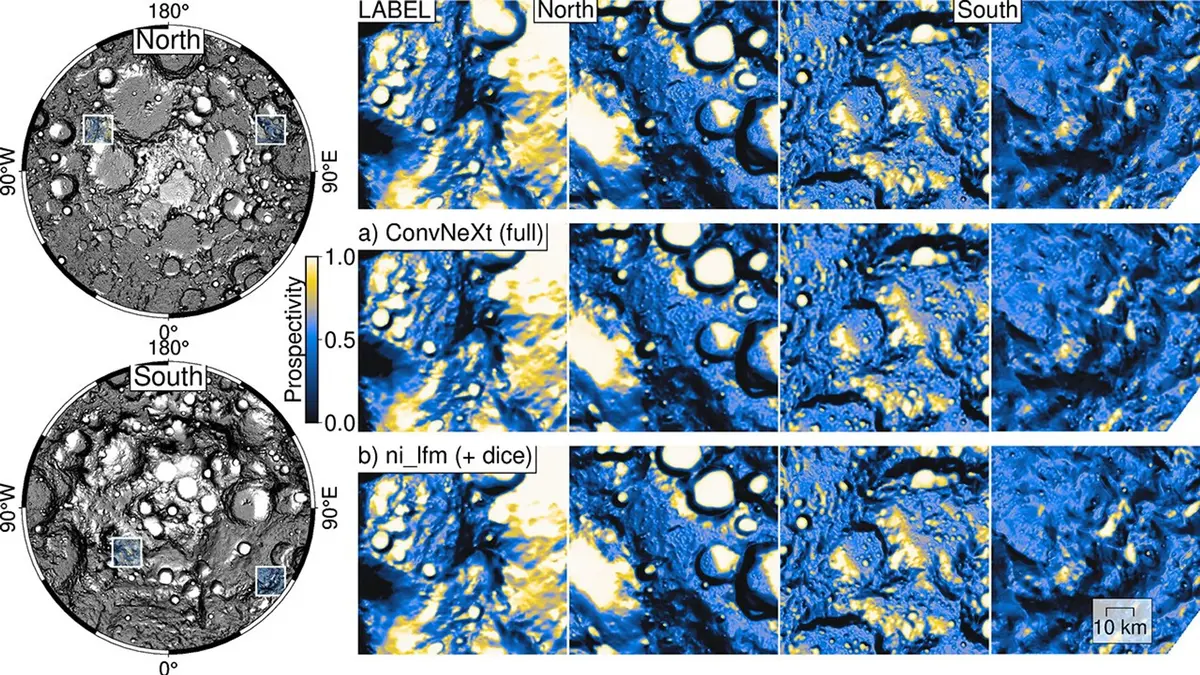
The collaborators highlight three application areas: estimating where water ice could remain stable near the poles, mapping irregular mare patches associated with the Moon's volcanic history, and finding or measuring craters. NASA also describes a test in which the model was adapted to identify a newly formed impact crater in before-and-after imagery.
IBM reports that the model reduced error in one lunar-ice task by as much as 22% relative to a SwinV2-B baseline. It also reports nearly 19% better performance at roughly 100-meter context scale for one crater task while using half the training data. Those figures are useful evidence of the authors' evaluation, but they remain collaborator-reported results rather than an independently replicated comparison.
Why open access is the bigger development
The model is publicly hosted on Hugging Face and its code is available on GitHub, with the release integrated into the open-source TerraTorch toolkit. That gives outside researchers a route to inspect, fine-tune, compare, and challenge the work instead of relying only on a closed service or a press-release benchmark.
For AI research, the release is another example of foundation-model methods moving beyond text and consumer products into scientific instrumentation. Its practical value will depend on independent use: whether lunar scientists can reproduce the reported gains, uncover failure modes caused by lighting and sensor differences, and turn faster mapping into better mission decisions.