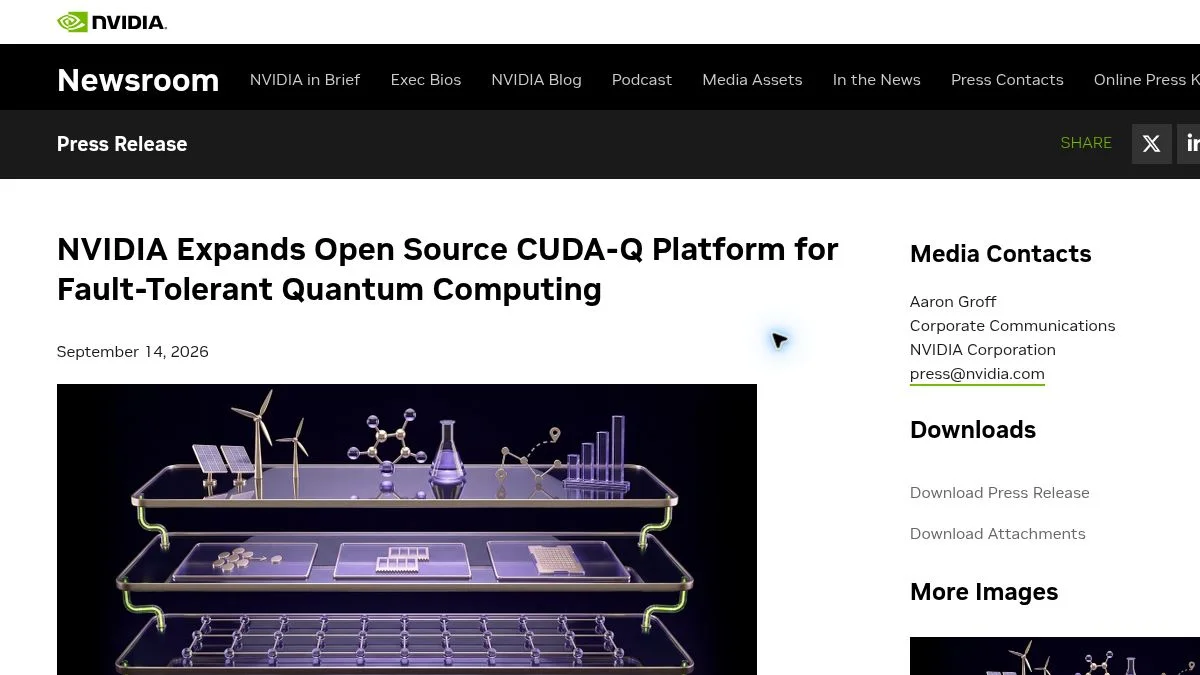
NVIDIA has expanded its open-source CUDA-Q platform with CUDA-Q Logical, an orchestration layer for designing and testing fault-tolerant quantum-computing systems. The release targets the codesign problem that links algorithms, error-correction codes, hardware architectures and quantum-processing units.
An open layer for logical-qubit system design
NVIDIA says CUDA-Q Logical lets researchers switch among the components of a fault-tolerant system and compare resource requirements through a programmable, verifiable workflow. The software is available through the CUDA-Q GitHub project, making this an open tooling release rather than a claim that useful fault-tolerant quantum computers are already deployed.
Early partner results remain source-reported
NVIDIA reports that Fermilab used the layer to reduce a fault-tolerant architecture-development workflow from about five months to three weeks. The company also says Sandia National Laboratories’ QUOPS benchmark is now available in CUDA-Q, while Iceberg Quantum modeled 1,000 logical qubits with 150,000 physical qubits—roughly one-tenth of a previous estimate for Diraq’s qubits. Those figures are partner and vendor reports in the release, not independently reproduced measurements.
What changed—and what did not
The material change is the availability of a broader open software workflow for quantum-GPU system exploration, alongside a hardware-agnostic benchmark reference. The announcement does not establish quantum advantage, a production fault-tolerant processor, or general performance across architectures; the practical value of the reported configurations still depends on independent evaluations and hardware progress.