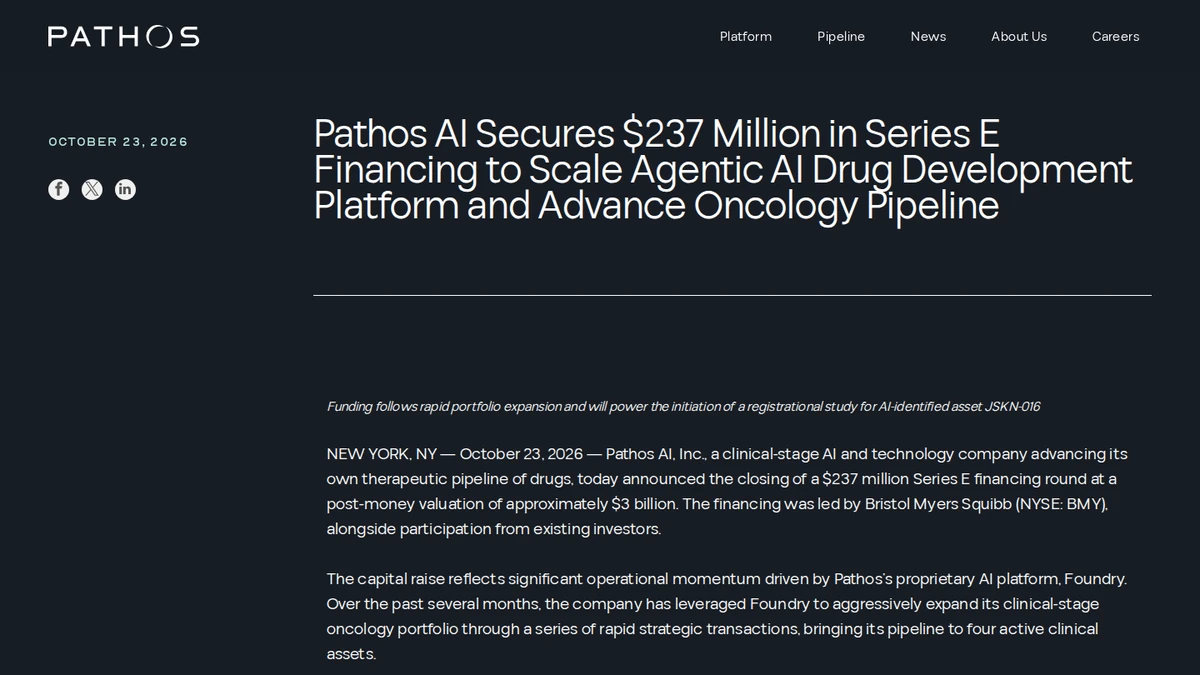
Pathos AI has closed a $237 million Series E financing led by Bristol Myers Squibb, valuing the clinical-stage AI drug company at approximately $3 billion after the investment. Pathos says existing investors also participated.
Capital for an AI-steered clinical pipeline
Pathos says the proceeds will expand its Foundry platform and advance a clinical pipeline that now includes four active assets. A priority is moving the antibody-drug conjugate JSKN016 toward registrational studies, alongside work on other oncology programs.
The company describes Foundry as a system of specialized AI agents that continuously combine clinical, genomic, biological and competitive information to guide portfolio and trial decisions. Those workflow and probability-of-success claims remain company descriptions; the financing does not validate therapeutic efficacy.
Funding arrives with a three-company neuroscience deal
Pathos also announced collaborations with Bristol Myers and Tempus focused on Alzheimer’s disease and other neurological conditions. Tempus is to assemble de-identified longitudinal records, while Pathos applies Foundry to hypothesis generation and trial design.
A Tempus regulatory filing says the neurology order can pay Tempus up to $55 million over five years, tied partly to delivery of 500,000 de-identified records. The filing also discloses related-party review because Tempus and Pathos have overlapping executive leadership and equity ownership.
The $237 million is equity financing, separate from the potential $55 million commercial data agreement. Neither amount is drug revenue, and the announced collaborations do not establish clinical success.