A new arXiv preprint proposes measuring how efficiently AI training can adapt when power availability changes. The authors introduce a Power Flexibility Index (PFI), arguing that power—not only chips or model demand—can become a scheduling bottleneck as accelerator clusters meet tighter grid constraints.
A metric built from GPU telemetry
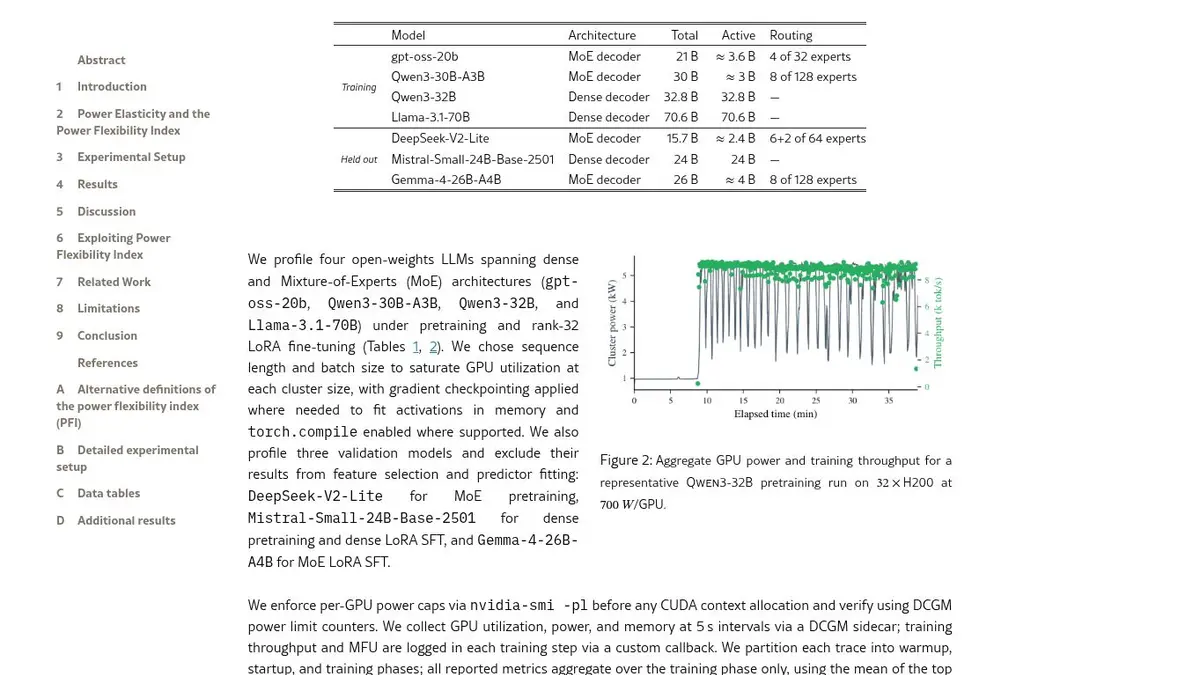
The study analyzes 131 H200 training runs, 24 H200 validation runs, and 34 matched H100 runs across dense and mixture-of-experts workloads, pretraining and fine-tuning, and jobs using up to 32 GPUs. It combines variable-power experiments with telemetry-based predictors to estimate how much throughput a job can retain as its power budget moves.
Reported gains under a 30% power reduction
At a 30% power reduction, the paper reports that a PFI-aware allocation recovers roughly 1,500 tokens per second per job and captures 63% of the gap between equal-weight allocation and a perfect-information oracle. That result is a preprint claim from the authors’ experiments, not an independently reproduced production benchmark.
A useful infrastructure question, not a deployment guarantee
PFI offers a way to compare jobs by their tolerance for power variation, which could help operators coordinate AI workloads with renewable supply, grid limits, or constrained data-center capacity. The public paper does not demonstrate a live cluster deployment, utility integration, or generalization beyond its tested GPUs and workloads. Whether the metric improves cost, reliability, or emissions at fleet scale remains an open question.