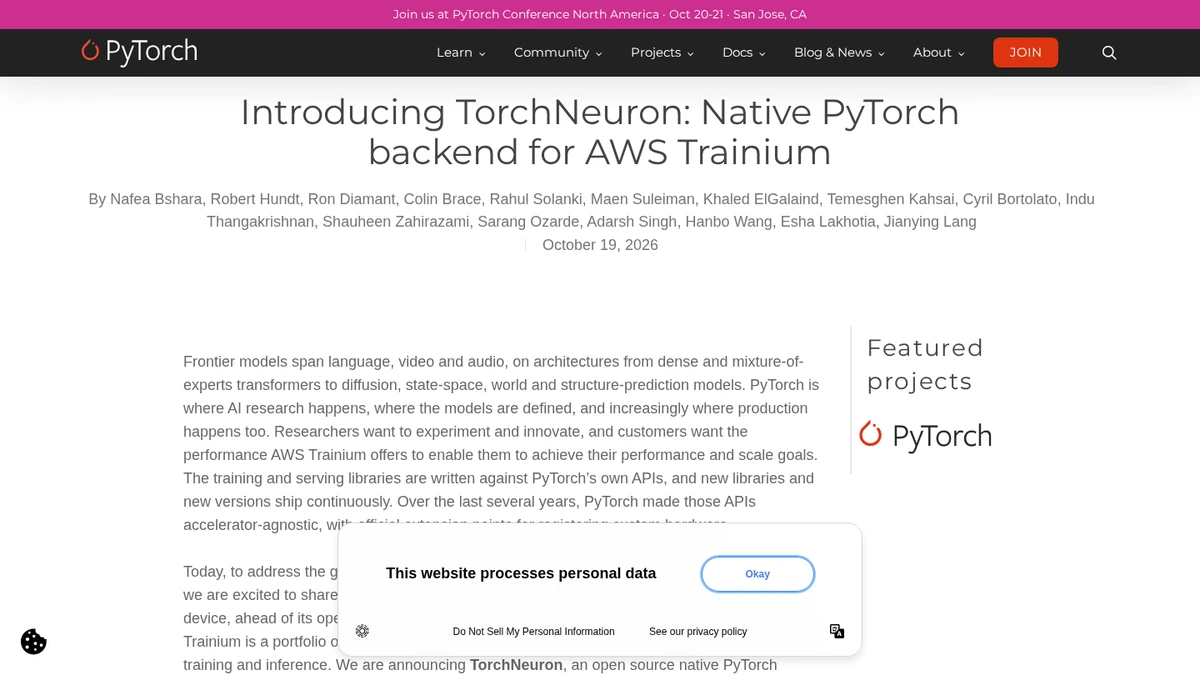
AWS launched the public beta of TorchNeuron on October 20, giving developers a native PyTorch backend for Trainium2 and Trainium3. A technical announcement on the PyTorch blog appeared October 19, ahead of the open-source release at the PyTorch conference.
The change addresses an important barrier to using alternative AI chips: the software work required to move an existing model. AWS presents the backend as a way to use familiar PyTorch APIs while selecting a neuron device, rather than rewriting the model around a separate execution model.
A familiar programming surface
The technical announcement describes eager execution for interactive work, torch.compile for compiled workloads and the Neuron Kernel Interface for custom operators. The public repository confirms the backend and its Apache-2.0 license.
That public code is a tangible release, but it is not evidence that every existing application will move without adjustment. The repository's compatibility guidance distinguishes supported operations from fallbacks and unsupported cases.
In particular, the current README says compiled workloads require static shapes and contiguous tensors, with new shapes causing recompilation. It also lists limited FlexAttention support and unavailable TorchAO integration in this release. Those details are narrower than a general promise of full compatibility.
More choice requires workload testing
For AI teams, the material development is a lower-friction route to evaluate AWS's accelerators using a widely used framework. Software portability can influence hardware choice even when an organization is satisfied with its current model architecture.
The release does not itself establish a universal cost or performance advantage over NVIDIA or another supplier. Compilation overhead, operator support, model behavior and service pricing all affect the outcome. The beta should be assessed against an actual workload, with compatibility and numerical behavior checked as well as throughput.