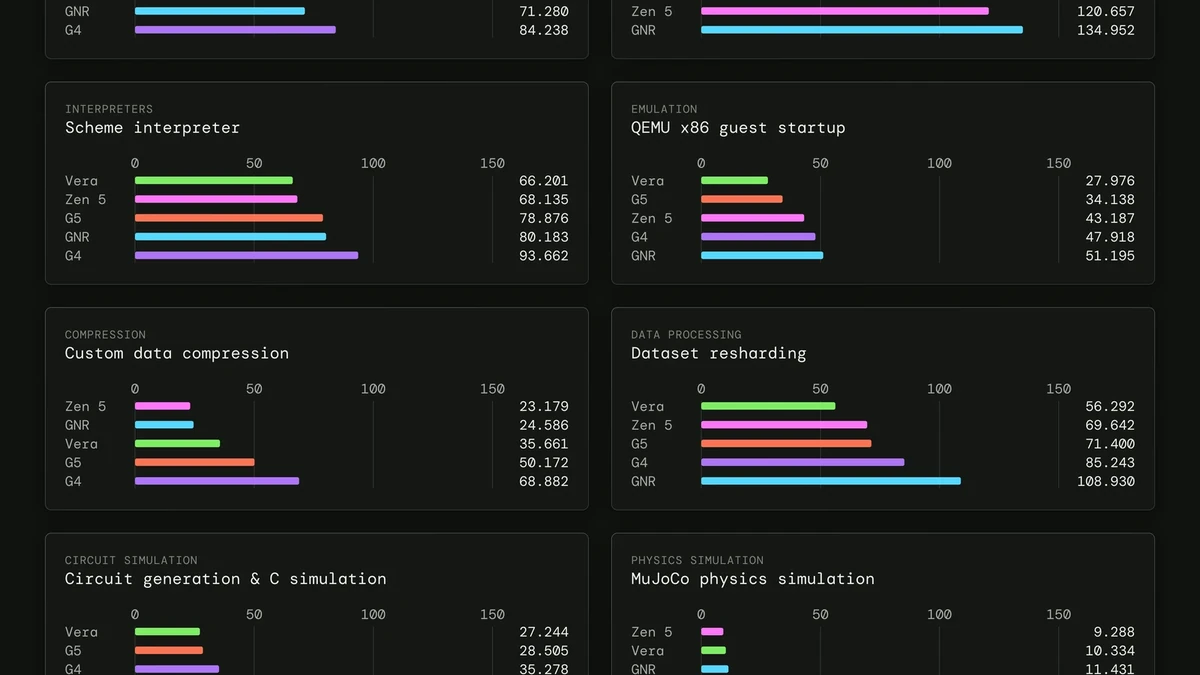
Modal reported on October 19 that NVIDIA's Vera CPU roughly doubled concurrent throughput on its sandbox benchmark compared with its existing baseline. The result comes from an early evaluation of the company's first Vera server, rather than a completed migration of its production fleet.
The test matters because an AI agent's work is not confined to model inference on an accelerator. Compiling code, running tests, manipulating files and using command-line tools all create CPU work in the environments where agents operate.
What was measured
Modal's Agentless Agent Bench replays 50 Terminal-Bench oracle workloads while removing network waits and language-model calls. Containers are prewarmed. The public repository exposes the benchmark approach, giving readers a way to inspect what the experiment includes.
Those design choices help focus the comparison on sandbox execution. They also narrow the result: the experiment is not a measurement of how long a complete agent takes to solve a task when model latency, network services and decision-making are included.
Modal reports separate serial-latency and concurrent-throughput comparisons. The chart reproduced with this article shows serial task latency; it is not the graph supporting the separate roughly twofold throughput claim. Individual serial results are mixed and much less dramatic.
A CPU result, not a universal speedup
The findings give Modal a reason to investigate a transition toward Arm-based infrastructure. They do not show that every application, programming language or workload will run twice as fast, or that the same improvement will survive at production scale.
For teams buying agent infrastructure, the useful lesson is to measure the environment around the model as well as the model itself. Modal's published harness makes the boundary of this particular test visible. Its figures remain vendor-reported and have not been independently reproduced by Signal.