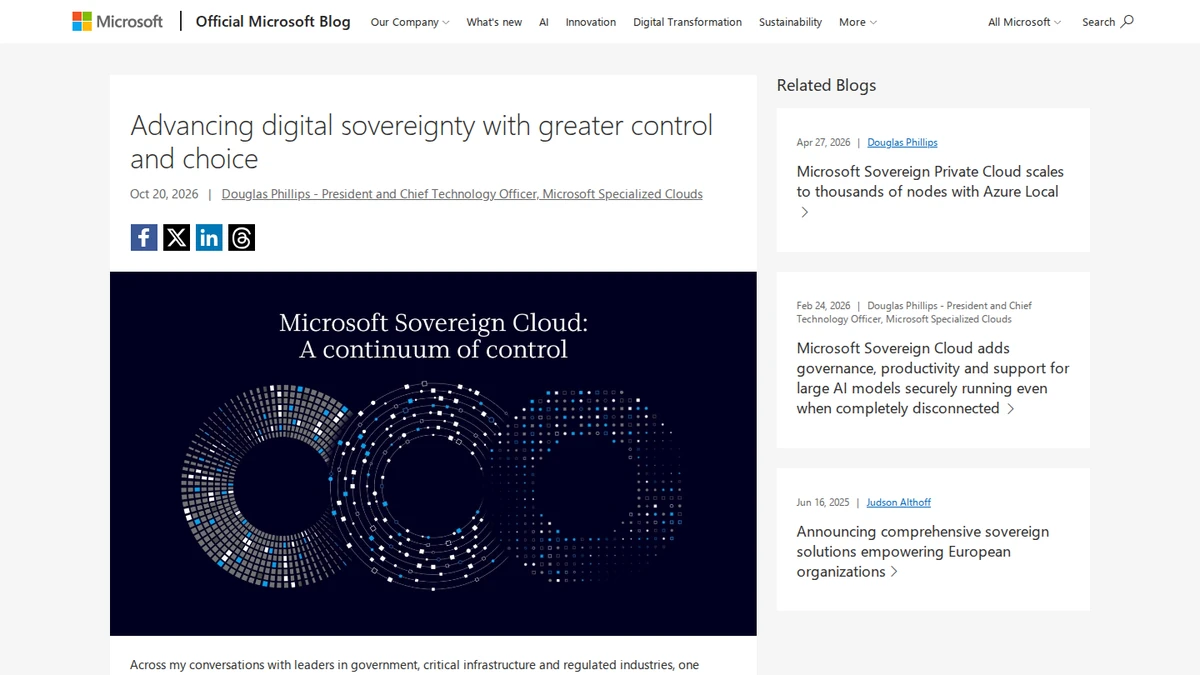
Microsoft announced a set of digital-sovereignty controls on October 20, extending how customers can manage encryption keys, local workloads and oversight of cloud operations. The package contains several different availability stages, making the distinction between a released feature and a roadmap item central to the news.
External key management for Azure Managed HSM and confidential virtual machines on Azure Local are generally available, according to Microsoft. These provide more concrete purchasing and deployment choices than features that remain in development.
A staggered release
Microsoft describes Data Guardian and Production Touch Ledger as a phased rollout in the EU and EFTA. Its connected-to-disconnected transition capability, DocumentDB on Azure Local and Blob Storage on Azure Local are in preview.
Other announcements look ahead to Ignite. A Sovereign Control Panel preview is planned for that event, while GitHub Enterprise Local and Foundry Local on Azure Local are scheduled to reach general availability there. They should not be read as already generally available simply because they appear in the same announcement.
Controls need to match a workload
The practical significance is that sovereignty requirements can involve several different questions: where data is processed, who controls a key, who can operate a service and whether a workload can continue without a public-cloud connection. A feature addressing one question does not automatically answer the others.
Customers comparing these options will need to map an individual service's stage and deployment conditions to their own requirements. Preview access, phased regional availability and a promised future release have different implications for a production plan.
The announcement establishes an expansion of Microsoft's control portfolio. It does not by itself prove that a particular configuration satisfies every jurisdiction's legal, security or operational requirements. That remains dependent on the actual workload, contractual arrangements and implemented controls.