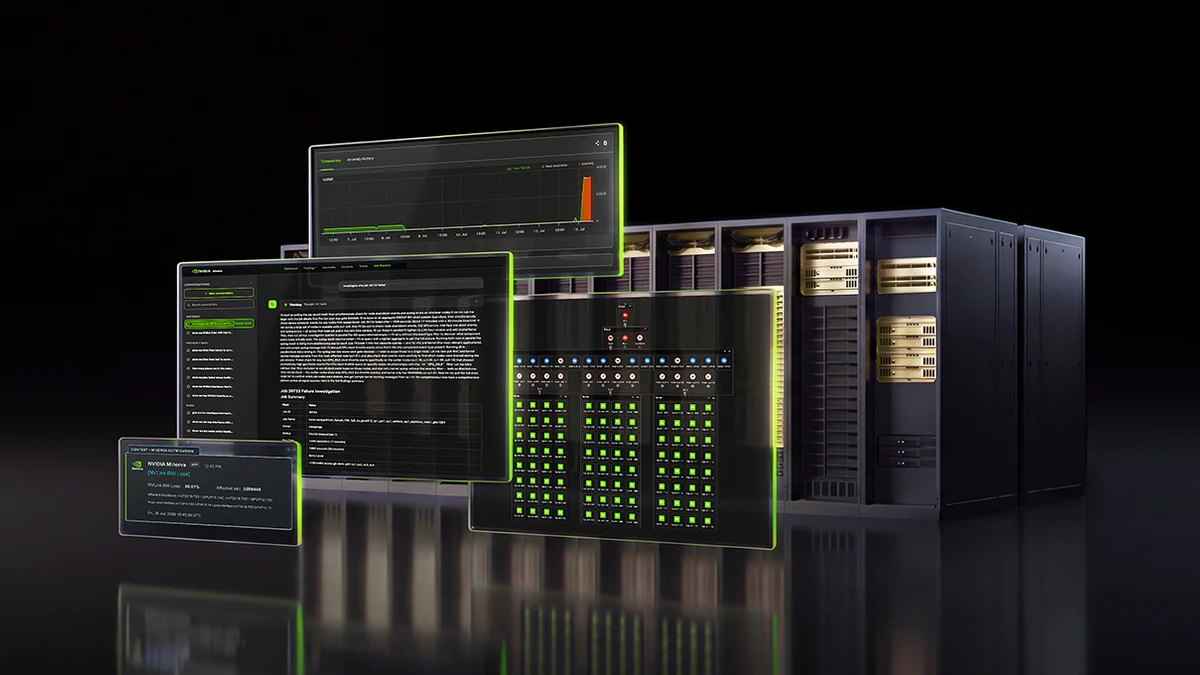
NVIDIA introduced Minerva on October 22, an AIOps platform designed to give operators one view across the infrastructure and workloads inside an AI factory. The product targets a practical constraint in large GPU clusters: one degraded component can slow a distributed job even when the rest of the system appears healthy.
Linking hardware symptoms to model workloads
Minerva combines telemetry from NVIDIA GPUs, networking, storage, schedulers and running jobs. NVIDIA says it builds a dynamic knowledge graph of devices and workload relationships so operators can trace a slow job to the cable, switch, drive or accelerator affecting it.
The company says the platform analyzes billions of data points an hour, using supervised and unsupervised machine learning to learn normal behavior, detect anomalies, predict emerging failures and consolidate related signals into a smaller number of incidents. It also offers an assistant for querying live telemetry and recommending remediation.
AI infrastructure now has an operations layer
The release reflects a shift in the AI infrastructure market from buying accelerators to maximizing the useful work they produce. For costly clusters, uptime, goodput and token output can be as economically important as peak hardware specifications.
NVIDIA says IREN is using Minerva, while Aolani, Bitdeer AI, IBM, Jio, Lambda, Quake AI and Tesla plan deployments. Planned use should not be confused with completed results, and the company has not provided independent comparative benchmarks for failure prediction or repair time.